Green & Blueberry Logistics: smaller vehicles, a better urban delivery model
Karamoko Gaoussou and an urban logistics model for Grand Paris: electric vehicles, cargo bikes, microhubs and how to measure delivery performance.
Share article ↗
Editorial analysis based on company materials, the profile in TRUTH Magazine No. 1/2026 (pp. 22–23) and the referenced research. The company lists STC Enterprises as its strategic representation partner; its founder is an Honorary Ambassador of the Just Do It Association, TRUTH’s publisher. Information reviewed on 27 October 2026.
Company at a glance
- Brand
- Green & Blueberry Logistics
- Founder & Director
- Karamoko Gaoussou
- Initial focus
- Paris and Grand Paris, France
- International outlook
- New York — strategic development
- Initial fleet model
- Target: five eQuads; deployment subject to validation
- Service framework
- MOVE · MANAGE · TRANSFORM
- Strategic representation
- STC Enterprises
- Website
- green-blueberry.eu
- Representation contact
- support@stc.enterprises
- Representation phone
- +48 71 880 89 79
A city wakes up through deliveries. Before cafés open, supplies reach their back rooms; before an order reaches a customer, it passes through storage, sorting and the final delivery leg. This everyday movement is essential, but it takes place in streets shared with pedestrians, cyclists, public transport and residents. The future of logistics is therefore also a question about how cities use their space.
Green & Blueberry Logistics, developed by Karamoko Gaoussou, presents a model combining urban deliveries, compact electric vehicles and the gradual development of operational support. Grand Paris is its starting point. This article examines the business and the mechanisms through which appropriately sized transport can better match urban consignments, bringing the company's proposals into dialogue with European publications and last-mile research.
Karamoko Gaoussou: a human perspective on logistics
Pages 22–23 of the first TRUTH Magazine issue introduced Karamoko Gaoussou as Green & Blueberry Logistics' founder and an Honorary Ambassador of the Support Center Association “Just Do It”. His profile describes an international supply-chain background, including experience associated with Kühne + Nagel and Iron Mountain. The company's current presentation emphasises service reliability alongside responsibility towards people and their surroundings. [1]
That perspective has practical implications. A delivery involves more than selecting the shortest route: it includes customer contact, the courier's working conditions, a safe stop, handling the load and resolving exceptions. A well-designed process should consider all of these elements. For a developing business, the sequence matters too: understand local demand and delivery requirements, test the operation, then expand its scale.
The last mile is also a street-space problem
The last mile is the final delivery leg to the recipient; it is not necessarily one mile long. Its complexity often comes from the number of addresses, limited stopping space and the need to match routes with customers' availability. A vehicle may cover most of its route efficiently yet lose time looking for parking, finding an entrance or returning after an unsuccessful attempt.
Research by Maxwell Schrader and colleagues in 2024 highlights delivery service time, including searching for parking and walking to the destination. The authors also identify limited comparable data on cargo-bike and van operations in the same urban settings. Their work supports assessing the complete delivery process rather than judging performance through driving speed alone. [5]
A shop needs its stock before opening; residents need an unobstructed pavement; an operator needs a route without unnecessary returns. These requirements should be considered together. An improvement in one part of the process may lose its value if the underlying problem is simply moved to the next location.
What electric propulsion changes
The European Environment Agency says that a typical electric car in Europe generates fewer lifecycle greenhouse-gas emissions than a comparable combustion vehicle. There are no exhaust emissions while driving, but battery production, electricity and tyre and road wear remain part of the environmental balance. Benefits depend on the vehicle, its use and the electricity mix. [2]
For urban deliveries, electrification can reduce local exhaust pollution without implying zero overall environmental impact. The EEA also stresses that electric propulsion alone does not resolve congestion or demand for road space. [2]
A smaller vehicle can be a better match
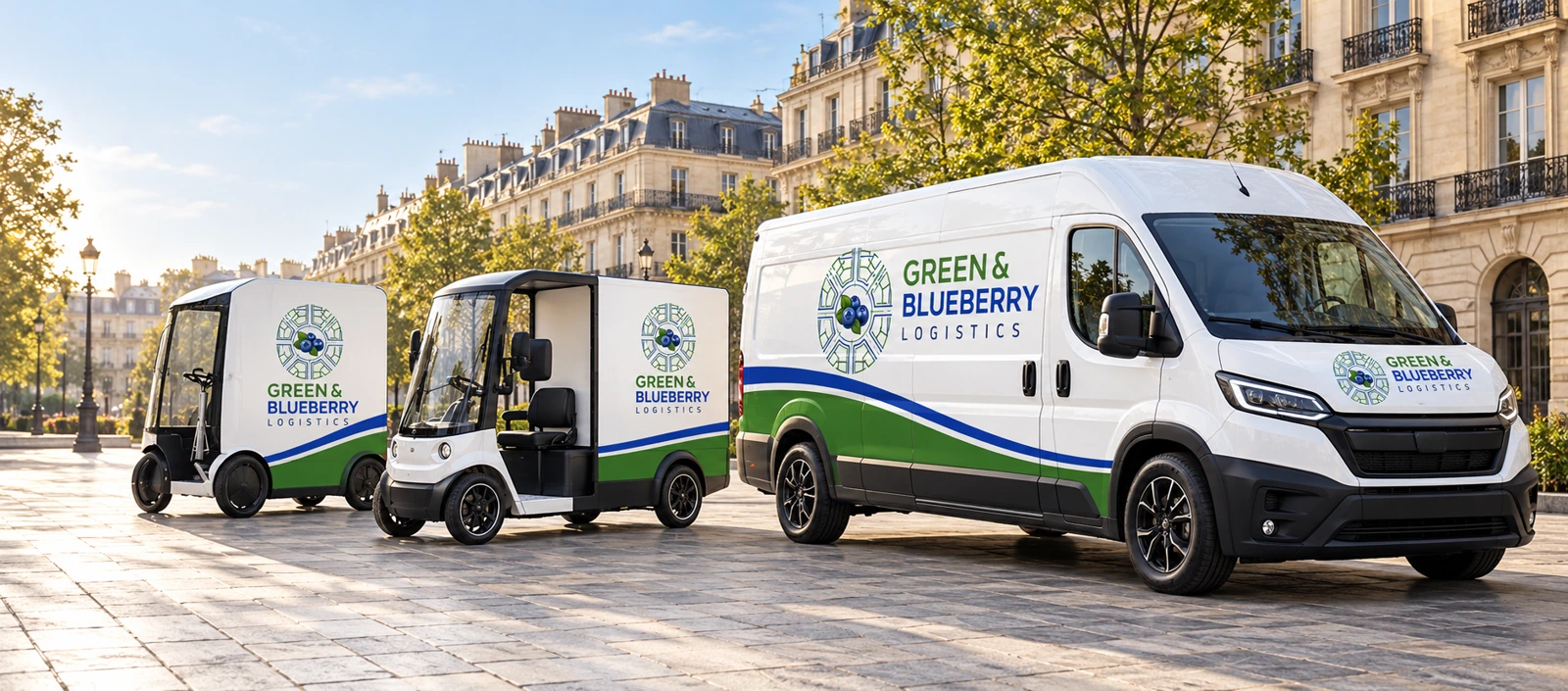
When a few small parcels travel in a large, lightly loaded van, some street space is effectively being used to carry spare capacity. A compact vehicle matched to the load can occupy less space while travelling and stopping. Where addresses are close together, a suitable legal stopping place and a shorter walk to the customer may also be valuable.
The whole route still needs assessment. If a smaller vehicle requires repeated journeys to collect the same load, its advantage may shrink. Weight, volume, distance, weather, infrastructure and handling time all matter. From an editorial analytical perspective, the aim should be to reduce unnecessary transport activity while maintaining the service the recipient needs.
Cargo bikes, light delivery vehicles and cars are different technical categories. Access rights, driver requirements and stopping arrangements depend on the specific vehicle and local rules. A route suitable for a bicycle should not automatically be assumed accessible to an electric quadricycle. Matching the vehicle to its legal and physical operating environment is part of responsible planning.
The microhub: bringing distribution closer
A microhub is a small transfer point close to the delivery area. Goods can arrive in a larger vehicle and then be divided into shorter rounds using lighter transport. The EU Urban Mobility Observatory describes such arrangements as a way to combine consolidation with cargo bikes and other low-emission delivery modes. [3]
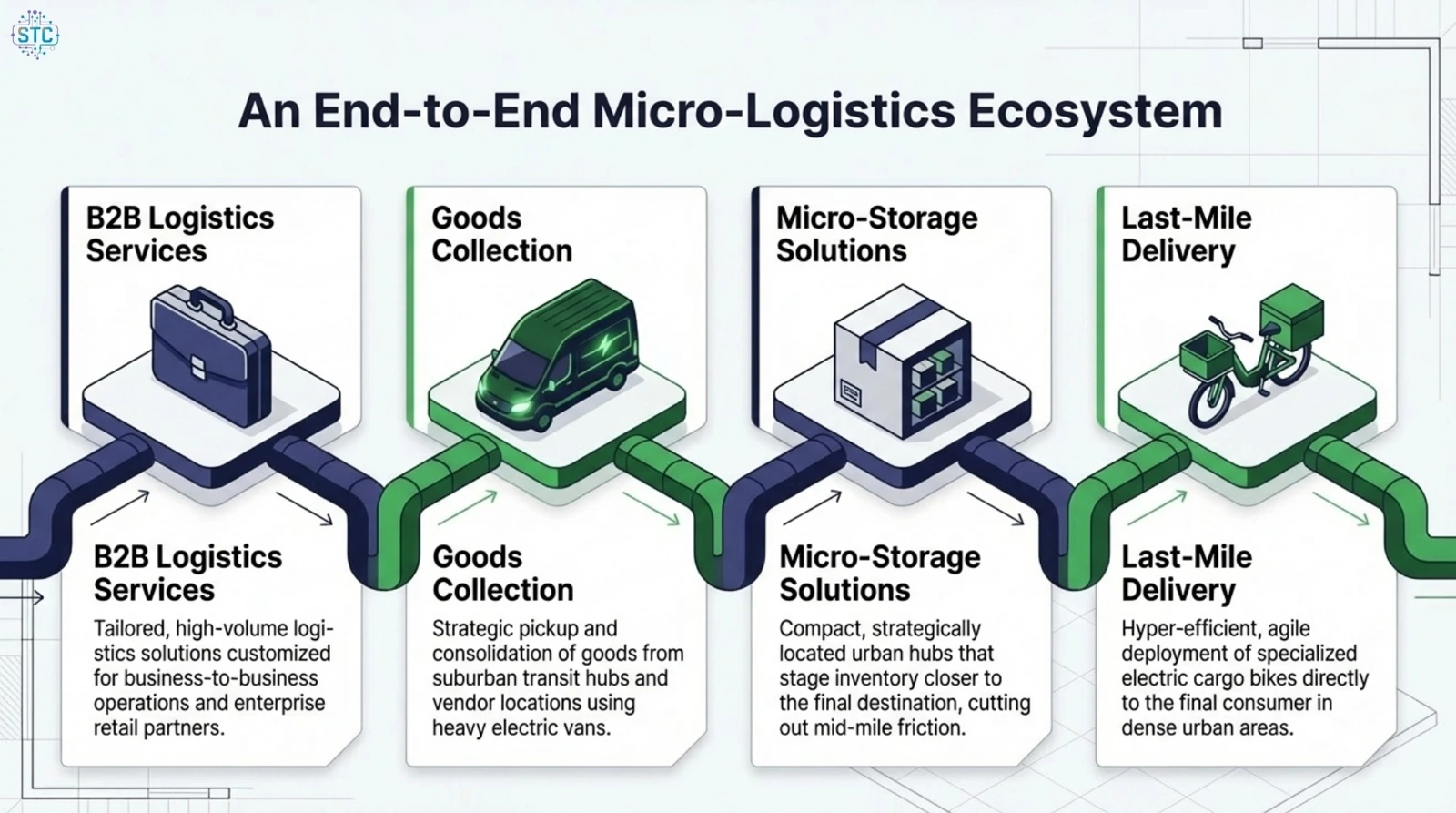
Location and operation are critical: the site needs to fit real freight flows, allow safe handling and avoid creating new conflicts with its surroundings. Green & Blueberry presents urban storage and order preparation as developing capabilities. The supplied process diagram connects collection, micro-storage and final distribution; it illustrates a proposed workflow. [1][3]
The company's framework: MOVE, MANAGE, TRANSFORM
Green & Blueberry organises its presentation around three directions. MOVE covers collection and delivery, including last-mile service, express requests, B2B distribution and replenishment. Paris and nearby Grand Paris territories are the initial focus. Routes, availability and handling requirements are to be agreed individually. [1]
MANAGE concerns developing capabilities for organising the flow, including storage, preparation, returns and operational visibility. TRANSFORM describes a progressive approach to adapting logistics, selecting transport modes and testing solutions. The framework helps distinguish an immediate customer requirement from the supporting process and the company's longer-term development. [1]
For a small business, the starting point might be one recurring collection. For a network of outlets, it could be a scheduled replenishment route. A community organisation might require regular transport of a particular type of goods. Each application needs specific addresses, times, dimensions, frequency and a responsible recipient before operational suitability can be assessed.
Treating the fleet as a working tool
The company's Growth launch model targets five eQuads. This is a planned initial fleet objective, with selection, configuration and deployment still subject to validation. Cargo bikes, electric vans, hubs and digital tools form part of the wider development roadmap. New York is presented as a strategic outlook. [1]
A sound vehicle decision starts with consignment data. Typical parcel weight, maximum dimensions, stop count, handling breaks and charging access need to be understood. Maintenance, spare parts, load security and working conditions also belong in the assessment. Investment should respond to a recognised need, while subsequent stages provide opportunities to revise assumptions.
What a well-designed route might look like
Consider a hypothetical neighbourhood with a bakery, a bookshop and several small retailers. Rather than organise every movement independently, an operator could examine whether selected orders fit a shared schedule. The courier receives a prepared load arranged around the stop sequence, while recipients know the agreed delivery windows.
Not all goods can be combined. Food may have different handling requirements from books, and an urgent request may not fit routine replenishment times. Planning needs to address secure loading, appropriate transport conditions and possible return collections. This is an illustration of process design, not an account of an established Green & Blueberry route or a measured saving.
A pilot should first establish a baseline, then compare alternatives providing similar services. Travel to the hub, transfer handling and return trips should all be counted. Only the full picture can show whether a smaller vehicle reduced distance travelled or the time spent occupying delivery space.
Lessons from European pilots
A Logroño pilot described by the EU observatory combined a microhub with electric cargo bikes. Launched in June 2025, it enabled goods to be transferred from vans to lighter delivery vehicles. It provides an example of a tested arrangement, separate from Green & Blueberry's own activity. [4]
An ULaaDS case study covering Bremen and Mechelen also highlights collaboration between local authorities, operators and businesses. Results varied with location and stakeholder engagement. For a developing enterprise, the practical lesson is to understand a particular neighbourhood and its participants before transferring a model from elsewhere. [6]
Couriers and recipients at the centre of service quality
A responsible logistics model should allow time for safe unloading, breaks and customer contact. A plan that works only through constant rushing or unlawful stopping transfers costs to workers and the surrounding community. Delivery windows, responses to delays and acceptable workloads should therefore be realistic and clearly defined.
Communication with recipients matters too. Entrance instructions, unloading information or notice of a timing change can prevent an extra visit. Digital tools can support that contact, but need clear responsibilities and appropriate data protection. The company presents route planning, proof of delivery and customer access as development directions; availability should be confirmed for a specific service. [1]
Metrics worth measuring
One group of indicators includes kilometres per successful delivery, empty running and capacity utilisation. Another covers punctuality, repeat attempts and stopping time. A third concerns energy use, the cost of the whole process and working conditions. One favourable figure can hide a problem elsewhere. This is an editorial proposal for evaluating a pilot, rather than a report of the company's operating results.
Comparisons should cover similar services and consistent measurement boundaries. An emissions assessment needs to explain whether it concerns exhaust at street level, operational energy or a wider lifecycle. A cost assessment should include labour, facilities and maintenance. A clear framework helps partners identify where a model works best and what needs to change.
Urban logistics starts with the appropriate scale
The most interesting aspect of Green & Blueberry's proposal is its attempt to connect transport with local circumstances. The company identifies Grand Paris as the setting for gradual development and partnerships as a way of validating its model. Its stated approach uses a focused beginning to support learning before expansion. [1]
For a city, the potential value is reliable delivery with less pressure on streets. For a business, it is a predictable service matched to its needs. For a courier, it is a process designed with respect for their work. Electrification, appropriate vehicle sizing and consolidation are tools serving those objectives. Their value emerges on specific routes, with specific loads and through results that can be measured honestly.

Contact and further information
STC Enterprises — strategic representation contact
green-blueberry.eu ↗
support@stc.enterprises
+48 71 880 89 79
Sources and background
- [1] Green & Blueberry — company profile and planned fleet ↗
- [2] European Environment Agency — Electric vehicles ↗
- [3] EU Urban Mobility Observatory — Microhubs (14 April 2025) ↗
- [4] EU Urban Mobility Observatory — DECARBOMILE, Logroño (7 August 2025) ↗
- [5] Schrader et al. — Urban context and delivery performance (2024) ↗
- [6] EU Urban Mobility Observatory — ULaaDS case study (19 December 2025) ↗
- Company — MOVE / Grand Paris ↗
- Company — fleet and technology roadmap ↗
- Company — strategic representation and contact ↗
- TRUTH Magazine — Karamoko Gaoussou profile ↗
- TRUTH Magazine No. 1/2026 — pp. 22–23 ↗