IBRO: from Crisis Volunteer to civic resilience
How Just Do It and BOSPoland’s Crisis Volunteer collaboration developed into IBRO: Kamil Sadzik, Ivan-Oleksandr Yakymiv and preparing people to help responsibly.
Share article ↗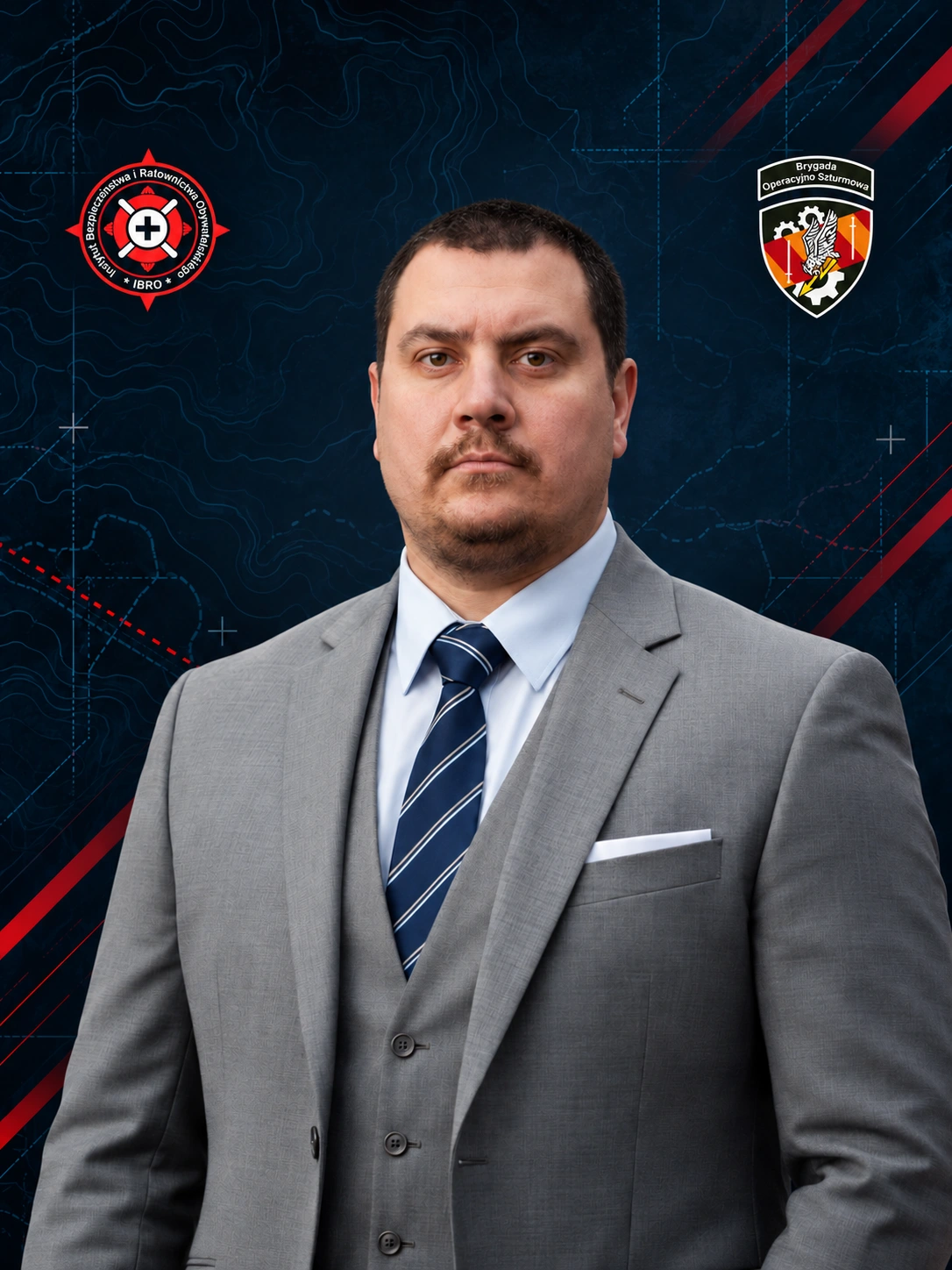
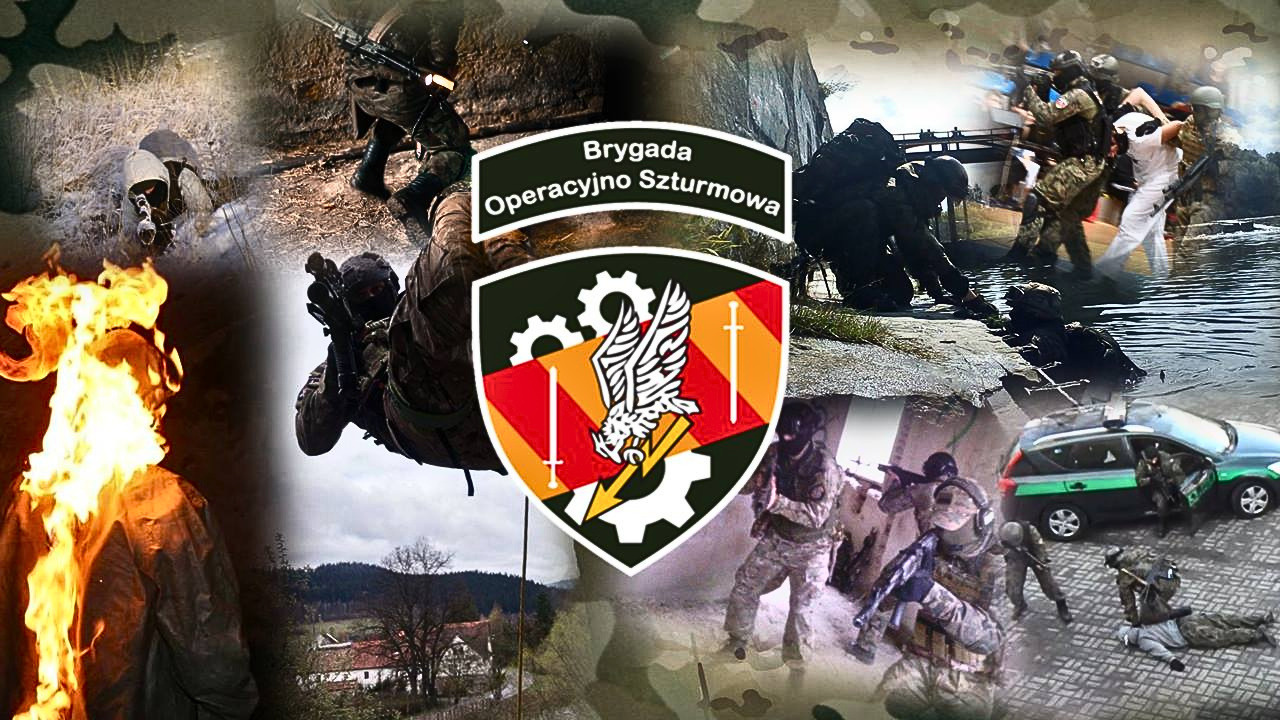
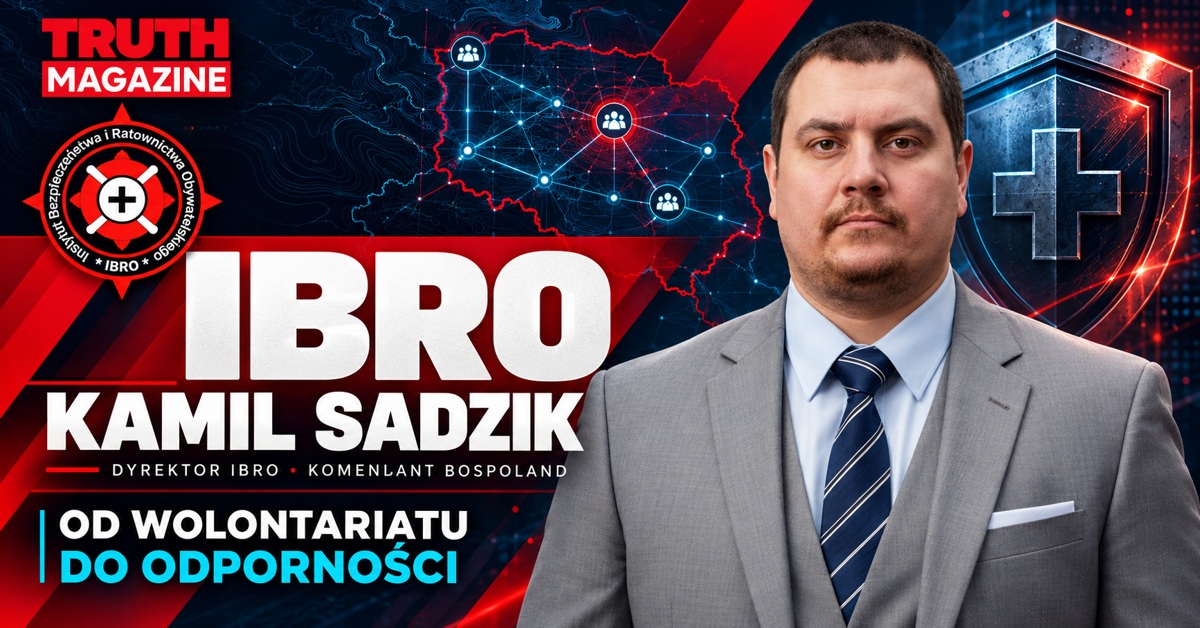
Editorial feature based on TRUTH’s first issue, IBRO’s organisational concept and the public sources listed below. IBRO operates within the Just Do It Association, TRUTH’s publisher, in collaboration with BOSPoland. Ivan-Oleksandr Yakymiv is the Association’s President and the magazine’s publisher. The organisational structure describes the institute’s concept; event examples come from organisers’ public announcements. Reach and qualifications have not been independently audited. The cover is an editorial visualisation using Kamil’s magazine portrait; the internal collage is from issue 1/2026. Materials reviewed on 29 October 2026.
Initiative at a glance
- Director
- Kamil Sadzik
- Collaboration
- Just Do It × BOSPoland
- Originating project
- Crisis Volunteer — materials since 2024
From preparedness to responsibility
A crisis exposes the difference between wanting to help and knowing how to act. Someone must organise information, someone must look after equipment and transport, and someone must prepare the people who may find themselves beside an injured person. This is where two organisations met: the Just Do It Support Center Association and BOSPoland. Their collaboration on the Crisis Volunteer project became the foundation for the development of IBRO, the Institute of Public Safety and Crisis Response. It is a story of combining civic commitment with training experience, then giving that combination a more durable structure. [2]
The institute is led by Kamil Sadzik, BOSPoland’s commandant and IBRO’s director. On the Association’s side, Ivan-Oleksandr Yakymiv, President of the Management Board of Just Do It and founder and publisher of TRUTH Magazine, provides the organisational leadership. The joint project shows how different capabilities can complement each other: instructors need an organisational foundation, while a civic organisation needs people who can translate a programme into meaningful exercises. The central concern is the learner: someone expected to help safely, understand their role and recognise when action must be handed over to professional services.
BOSPoland: from a community of enthusiasts to education
In material published in TRUTH’s first issue, Kamil Sadzik describes BOS as originating among friends interested in simulations and airsoft. His account places the earliest meetings in December 2008 and the development of organised activity in 2009. Over time, the emphasis shifted from participation in events towards sharing knowledge. This history does not need an invented military legend: its substance is the evolution of an interest into responsibility for the quality of teaching others. [2]
BOSPoland currently presents its activities as education encompassing first aid, bleeding control, survival, field preparedness and training for different audiences. These strands should be understood separately. A session for school pupils has different objectives from a volunteer workshop or a course intended for people working professionally in security. Preparedness under pressure may be the shared theme, but difficulty and responsibility must be appropriate to the participants. [4]
Crisis Volunteer came first
Just Do It’s public records help clarify the chronology. Its archive lists an announcement opening registration for Crisis Volunteer, under Ivan Yakymiv’s name, on 24 September 2024. Kamil Sadzik’s extended material on volunteer preparedness followed on 7 October 2024. The project therefore preceded the institute described later in the magazine. IBRO should be understood as a development of that collaboration, rather than the point at which crisis education first began. [3]
That sequence matters. First comes a need and an attempt to answer it: how should people willing to help during emergencies be prepared? Then comes the need to organise knowledge, divide responsibilities, support instructors and improve materials. An institute can address that second stage. Rather than relying entirely on individual events, it creates a framework in which experience from successive courses can be compared, updated and passed on to new instructors. This transition from an initiative to a repeatable process is the most interesting part of IBRO’s story.
Two capabilities that a logo cannot replace
The institute’s concept makes the division of capabilities clear. The Association contributes organisational structures, access to a volunteer community, project support and the ability to build civic cooperation. BOSPoland brings instructors and training experience. This arrangement works only when both sides remain active: efficient registration cannot replace a good instructor, while even the best instructor cannot sustain a programme without communication with participants, practical organisation and responsibility for delivery. [2]
The collaboration is therefore more than two names lending their patronage. Its value can be assessed by whether participants receive consistent information before training, whether exercises meet their needs and whether they understand what they have actually learned afterwards. For Just Do It, it is also a way to develop volunteering: moving from a general willingness to help towards defined responsibilities. For BOSPoland, it offers a way to place practical knowledge within a broader civic project that reaches beyond one community or location.
Ivan-Oleksandr Yakymiv: the organisational foundation
Ivan-Oleksandr Yakymiv’s role in this story follows from his responsibility for the Association. As President of Just Do It’s Management Board, he connects the development of civic initiatives with the structures needed to sustain them beyond a single campaign. IBRO’s concept places the institute within the Association, working with BOSPoland. It is a model that links civic and organisational support to the institute’s subject-matter leadership. It does not describe a separate state authority or a military unit.
From an organisational perspective, this is a consequential choice. A training project needs more than a syllabus: it needs a place where decisions are made, responsibilities assigned and experience retained. Yakymiv’s contribution can therefore be understood as creating the conditions for the collaboration’s institutional development. Within this arrangement, Kamil Sadzik leads IBRO’s substantive direction, while the partnership with the Association connects that work to a wider civic purpose: preparing people to participate responsibly in helping others.
Kamil Sadzik: instructor and director
Sadzik combines his position as BOSPoland’s commandant with the leadership of IBRO. The two roles meet in the question of how experience should be transferred. Personal proficiency is not yet an educational programme. An instructor must choose tasks appropriate to a group, explain their purpose, recognise mistakes and guide a safe correction. An institute director must also consider other instructors’ work, consistency of teaching and the distinction between a demonstrable skill and attendance at a course.
This matters particularly in civilian training. A participant should not leave a workshop believing that a short course confers professional qualifications or prepares them for every emergency. Responsible education increases preparedness while teaching people to recognise their limits. Its most valuable outcome may be less a spectacular demonstration than a calmer assessment, better cooperation and an understanding of where one’s preparation ends. This is a useful way to understand IBRO’s connection between instructor development and volunteer training.
Five areas, one standard of responsibility
The concept materials and the magazine’s first issue organise IBRO’s remit into five areas: tactical training; rescue and combat medicine; crisis management and volunteering; standards and certification; and operational and logistical support. This structure should be read as a division of responsibilities, rather than automatic proof of operational scale. Its practical value lies in distinguishing teaching quality, instructor preparation and equipment organisation instead of treating them as one undifferentiated task. [2]
For civilian participants, the most relevant elements are those that match their role: first aid, organising support, cooperation and preparedness for difficult conditions. Specialist modules require a separate approach to selecting participants and instructors. Standards are equally important. If an institute aims to develop a repeatable educational model, it must explain which skills it assesses, by what criteria and how the programme is updated. A programme certificate is not the same thing as a statutory professional qualification.
STOP THE BLEED: knowledge that needs practice
Bleeding control is a visible part of BOSPoland’s activity. The American College of Surgeons explains the purpose of this education as equipping the public to respond to life-threatening bleeding. ACS also states that the practical component remains necessary to complete its course and obtain its certificate. This distinction matters for online learners: digital materials may prepare someone for exercises, but should not be treated as equivalent to complete hands-on training. [5–6]
The institute’s account should therefore emphasise teaching quality rather than unverified statistics or promises of universal effectiveness. A photograph of a tourniquet, or familiarity with a procedure’s name, does not demonstrate mastery. Readers are entitled to ask about the programme, instructors’ qualifications, practical exercises and assessment. This article describes an initiative and its rationale; it is not a medical procedure guide, nor does the use of a programme’s name by itself verify an individual’s authorisation.
Schools, local communities and events
BOSPoland’s public activity list describes work across different settings. Its 2026 entries include cadet training in Żywiec, sessions for youth fire teams in Kuków and STOP THE BLEED workshops at AZR X. These are examples reported by the organisation, not independently audited findings. They nevertheless illustrate the range of intended audiences, from young people and local communities to participants in specialist events. More significant than the number of logos is how a programme is adapted to each group’s needs. [4]
Working with a school requires a different language from a session for people involved in rescue work. Age, experience and participants’ abilities require careful attention. Local activities also depend on cooperation with the host, whether a school, organisation or another institution. For IBRO, this variety can provide insight into what should be standardised and what should remain adaptable. A shared standard need not mean the same programme for everyone. It should mean comparable care for safety and quality.
Training partners and promotional relationships
Alongside its connection with the Support Center Association, BOSPoland’s official link directory includes references to JB Tactical, Rhino Rescue, FlareSyn, Za-Pas Knives and WarriorGear.eu. Some are presented as discount or promotional arrangements. They should therefore not automatically be treated as IBRO institutional partnerships, course accreditation or independent assessments of equipment quality. Precision makes the account more credible and distinguishes co-development of a civic programme from commercial communication. [4]
Equipment matters, but cannot replace a teaching method. Relationships with manufacturers may help instructors explore tools and applications, yet a responsible programme should separate educational aims from promotion of a particular product. Learners need a clear exercise objective, appropriate equipment and an understanding of limitations. For an institute, transparency matters: an announcement should explain whether a relationship concerns training, equipment access, promotional material or a joint project.
How civic resilience should be assessed
The hardest questions arise after a session ends. Can participants use what they learned several weeks later? Do they understand cooperation? Can they identify tasks they should not undertake alone? The audience for educational materials and the number of trained people are different measures, and neither replaces assessment of competence. The first TRUTH issue included claims about a broad reach; without a shared methodology and supporting records, this article does not present those claims as a verified total of IBRO graduates.
The institute’s further development can be assessed through programme consistency, instructor quality, transparent certification and the ability to improve materials after working with successive groups. Accessibility matters too: can someone outside a specialist community understand the offer and know where to begin? In this approach, civic resilience becomes more than a slogan. It is a process of building skills and relationships that improve the prospect of sensible, coordinated action in a difficult situation.
An institute as a commitment to the future
IBRO’s story brings together two strands: Kamil Sadzik and BOSPoland’s movement towards education, and the civic structures developed by Just Do It under Ivan-Oleksandr Yakymiv’s leadership. Crisis Volunteer became their meeting point. The institute provides a framework for developing programmes, teaching instructors and organising experience. Its significance, however, does not rest on its name. It rests on whether that ambition becomes rigorous, accessible and responsibly delivered preparation for real people.
Readers interested in the institute can consult ibro.institute, the Association’s materials and BOSPoland’s current announcements. Before enrolling, they should check the current syllabus, delivery format, participation conditions and the nature of the completion document. Good crisis education begins with that clarity: who is teaching, what is being taught and what level of responsibility that preparation genuinely supports.
Contact and further information
Stowarzyszenie Centrum Wsparcia „Just Do It”
ul. Żubrza 16/1, 54-229 Wrocław
pomoc@centrum-wsparcia.pl
centrum-wsparcia.pl ↗
Sources and background
- IBRO — strona instytutu / institute website ↗
- TRUTH Magazine nr 1/2026 — IBRO i materiał Kamila Sadzika, s. 14–16 ↗
- Just Do It — archiwum Wolontariusza Kryzysowego, wpisy z 2024 r. ↗
- BOSPoland — oficjalny wykaz działań, współprac i odnośników ↗
- American College of Surgeons — About Stop the Bleed ↗
- American College of Surgeons — FAQ i wymóg praktyki ↗