Just Do It. From an instinct to help to an international organisation for knowledge, volunteering and resilience
The story of the Just Do It Support Center Association follows a response to war that developed into work on security, education, health and cooperation across borders. At its centre remains the individual: someone needing help, someone willing to provide it, or someone whose knowledge can be shared.
Share article ↗
TRUTH Magazine is published by the Association described here. Based on the first magazine issue, supplied publications, public sources and the President’s account; reviewed on 2 November 2026. Organisational claims are attributed to their sources.
Article details
TRUTH Magazine Editorial Team · 2 November 2026
Print article / PDF2022. The need came first
The story of the Support Center does not begin with an institute or a magazine. It begins with people who, after Russia’s full-scale invasion of Ukraine, needed accommodation, food, information and help navigating an unfamiliar administrative system. In March 2022, eight people from Poland and Ukraine started the initiative that became the Just Do It Support Center Association. This is how its beginnings are described in the interview with Ivan-Oleksandr Yakymiv and in the Association’s materials. [1–3]
March marks the beginning of the initiative, rather than its registration. The Association was registered on 18 August 2022, under KRS number 0000983480, with its registered office in Wrocław. Distinguishing these dates reveals the sequence: action first, followed by the formal structure intended to sustain it. [4]
Initial assistance addressed refugees’ basic needs alongside legal and psychological support. These services were connected. Losing accommodation makes finding work harder; unemployment deepens dependence on assistance; unfamiliar languages and procedures can prevent access to solutions that formally exist. Effective support has to recognise these relationships.
The most important change in Just Do It’s development was therefore more than adding projects. It involved moving from “what should we provide today?” towards “what would help this person regain independence?”. Emergency assistance and integration became successive stages of the same journey.
The name Just Do It expressed a readiness to act. Over time, it also had to encompass less visible work: coordination, accountability, communication and continuity. Spontaneous mobilisation can launch assistance; organisation enables it to survive beyond the first wave of emotion.
2022–2023. Helping each other: from receiving support to building a community
One particularly important theme in the supplied interview concerns people who wanted to help others after receiving assistance themselves. This contributed to a community connecting refugees, volunteers and local residents. Its motto, “Helping Each Other”, describes a relationship in which no one is permanently reduced to being a beneficiary. [1, 2]
The distinction has practical consequences. Someone who recently completed a residency procedure may later help another person understand its stages. A bilingual participant can support communication. Someone attending a workshop may become a co-organiser. The value lies both in the service provided and in the restored sense of agency.
Educational, cultural and integration activities developed from this approach. Public materials place initiatives building skills and social connections alongside assistance with residence. Their common purpose is to make participation in a new environment easier.
Volunteering is neither a single occupation nor a single task. It includes organising, translating, preparing materials, contacting participants, facilitating meetings and helping at events. These roles require different qualifications, but all require clear responsibilities.
Growth therefore meant combining openness with preparation. There must be room for newcomers while recognising which tasks they can perform independently and where an experienced coordinator is needed. This is where volunteering meets management.
Nowy Dom: turning assistance into practical tasks
Nowy Dom makes integration tangible. Its public description offers free consultations, residence and employment assistance, document translation, housing advice, application preparation and communication with authorities. Employment support includes CVs and interview preparation. These are services described by the Association, rather than a published evaluation of every service’s effectiveness. [14]
The list reflects an important change of perspective. A migrant’s problem rarely fits into one form: an authority needs documentation, an employer needs clarity about employment eligibility, and a landlord wants financial stability. Someone seeking assistance has to understand these dependencies. An organisation can explain the sequence and help them navigate it without promising decisions on behalf of public authorities.
This work concerns access to existing solutions. A right to apply means little if someone cannot understand a letter or identify the documents required. Alongside specialist knowledge, patient explanations and organisation matter. Here, cooperation between experts, coordinators and volunteers becomes practical assistance rather than a statement of solidarity alone.
7 February 2024. Warsaw and an international perspective
In April 2024, the Support Center published Ivan-Oleksandr Yakymiv’s account of the Global Social Impact Summit 2024. He wrote as Vice President of the Management Board, describing an encounter between civic, public and business communities around crisis response, community resilience and cooperation across sectors. [3]
An international event does not replace everyday assistance. It can, however, change how an organisation understands its work. Needs that appear locally as individual cases are also part of broader processes: migration, unequal access to knowledge and difficulties coordinating volunteers. International contacts allow organisations to compare methods and discover approaches they do not need to invent again.
Warsaw, 7 February: where experiences met
Organiser records clarify the date. The Global Summit on Social Impact took place in Warsaw on 7 February 2024; 1 April was the date of Just Do It’s later account. Points of Light reported that the wider gathering on 6–9 February brought together more than 200 leaders from Poland and 25 other countries. The hosts were Points of Light and Stowarzyszenie Centrum Wolontariatu. [15]
The official preview identified three themes: bridging political divides, community resilience and cooperation in refugee support. Neil Bush attended as chair of the Points of Light Board of Directors, with a planned conversation with US Ambassador Mark Brzezinski. This provides independently documented context for Yakymiv’s photograph with Bush, rather than proof of a separate agreement between them. [16]
In his 14 February reflection, Points of Light board member Jeff Hoffman emphasised Ukraine’s war in the discussions and the value of comparing national experiences. He described an environment for learning from practitioners. Just Do It’s history belongs within that broader question: how can solidarity triggered by a sudden crisis become an enduring capacity to cooperate? [17]
For a team formed in 2022, this was an opportunity to connect direct experience with strategy. Assistance begins with a person and an urgent problem. A conference asks about systems, partnerships and transferring solutions. Development requires both perspectives: retaining sight of the individual while moving beyond dependence on improvisation.
Meeting Neil Bush
A documented image from this stage is the photograph of Ivan-Oleksandr Yakymiv with Neil Mallon Bush. It appears in the supplied materials, while TRUTH’s first issue returns to the encounter in its account of the 2024 summit. According to Yakymiv, the discussions encouraged reflection on leadership, civic engagement and long-term cooperation. [3, 5, p. 9]
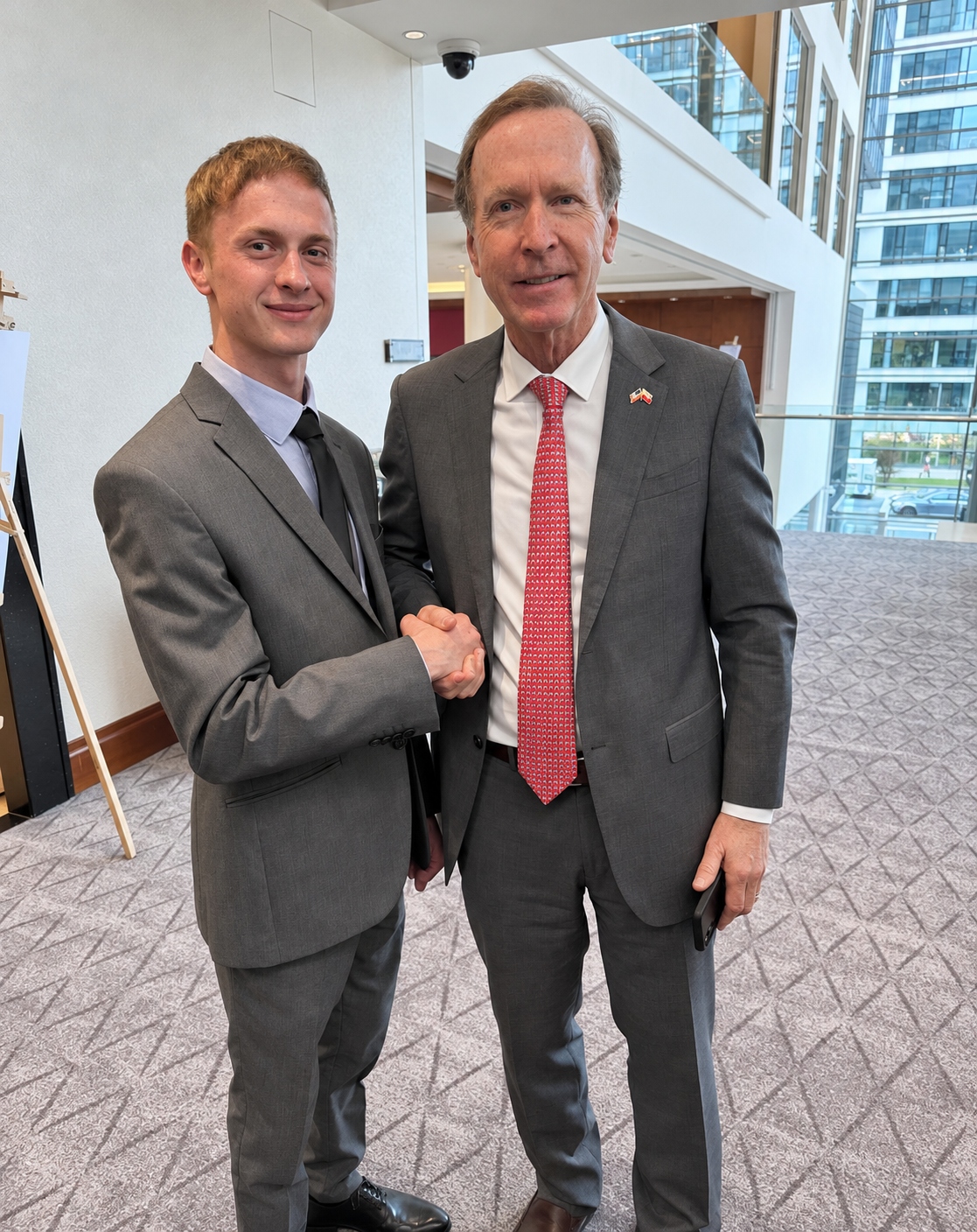
The episode should be described precisely. The available materials document a meeting and explain its significance through a participant’s account. They are neither a partnership agreement nor evidence that Bush financed the Association. The opportunity for dialogue and learning is the relevant part of Just Do It’s story.
For an organisation rooted in direct assistance, this represented another step: from responding to needs towards discussing how durable cooperation can be built. Attendance alone is not a social outcome. Value emerges when the experience returns to the team and improves its work.
2024. Crisis volunteering: goodwill needs skills
Another stage was the development of Crisis Volunteer, or Wolontariusz Kryzysowy. The Association’s materials and later TRUTH features describe cooperation between the Support Center and BOSPoland. The project aimed to prepare people willing to assist in emergencies, combining education with practical exercises. [5, pp. 14–17; 6]
This approach recognises the limits of willingness alone. A person may want to help during a crisis without knowing how to participate safely. Alongside specific skills, cooperation matters: following instructions, communicating information and recognising situations requiring professional services.
The Just Do It–BOSPoland relationship combines a civic and organisational foundation with instructors’ experience. The Association contributes networks, participants and coordination; the training partner contributes teaching practice. Giving this cooperation a durable structure later became one reason for establishing IBRO.
Participation and competence must be distinguished. Attending a workshop does not automatically confer professional qualifications. Civic education aims to improve preparedness for responsible assistance, while recognising the role of professional emergency services.
Preparation also includes logistics, emotions and responsibility
The course description published on 14 October 2024 presents more than an isolated rescue skill. Its stated objectives include coordinating assistance, logistics and prioritising resources, teamwork, personal safety, ethics and legal aspects of volunteering. It also identifies adapting support for women, children and older people. These are educational objectives, not automatic guarantees of every participant’s competence. [18]
In a separate article dated 7 October 2024, Kamil Sadzik discusses the psychological burdens of crisis work, including helplessness, survivor guilt and burnout. The organisational implication is that preparation does not end with assigning a task. People need awareness of emotional costs and room to discuss their limits. A public training article should not be treated as an individual diagnosis or authoritative legal interpretation. [19]
In Crisis Volunteer, maturity also means recognising when not to act without adequate preparation. This is compatible with courage. Acting without understanding a situation can create a need to rescue additional people. A responsible volunteer recognises their task, communicates information and accepts that their role may be supporting professional services and colleagues rather than taking command.
A shared language is therefore valuable. A team needs to know who gathers information, who communicates needs and who decides. Common terminology reduces misunderstanding when people from different occupations work together. This distinguishes a demonstration from preparation for cooperation: individual ability is insufficient unless people can work together.
2025. The Alliance for Good conversation: explaining the model
The supplied material includes a Polish publication dated 11 March 2025, updated in July, concerning a conversation with then Vice President Ivan-Oleksandr Yakymiv. An English version appeared on the Business & Philanthropy Forum website on 26 May 2025 as “Just Do It Support Center Association: Help Is Here”. These are dates of two publications, not a single confirmed date for the interview itself. [1, 2]
The Polish publication identifies Wei Zheng in connection with the Alliance for Good interview, presenting him as a co-founder and organisational leader. This provides relevant context: the conversation addressed both current assistance and the challenge of developing a civic initiative, sustaining funding and organising work across borders.


Wspólna Droga: from interviews to a culture of dialogue
Wspólna Droga was publicly described on 21 May 2025 and updated on 20 July. It aims to connect public administration, civic organisations, experts and citizens through interviews, workshops, analysis, online spaces and advocacy. Its stated methodology is deliberative participation: two-way communication requiring reasoned responses to citizens’ proposals. This describes an intended method, not proof that authorities have adopted every recommendation. [21]
The approach connects with Just Do It’s international contacts, but dialogue extends beyond meeting prominent people. The difficult work often follows: understanding an argument, assessing its practical relevance and involving those affected. Otherwise, even an impressive list of contacts remains an unused resource.
Dialogue matters particularly for institutes. An expert may understand a problem without knowing a volunteer’s or beneficiary’s daily constraints. Someone working directly with a community may identify a need absent from the existing programme. Conversation can turn that observation into a training topic or research question. Agreement on everything is unnecessary; a willingness to explain the reasoning is essential.
Wei Zheng: philanthropy and connecting resources
Wei Zheng, also known as John Wei Zheng, is a co-founder of Alliance for Good. His Obama Foundation profile describes advisory work for philanthropists, foundations and business leaders, and an interest in mobilising resources for communities. It also confirms his participation in the 2019 Leaders Asia-Pacific programme. It does not establish that he served as the Foundation’s regional director for Asia-Pacific. [7]
The supplied Polish publication attributes more than ten years of fundraising and philanthropic-services experience to him. The interview with Just Do It’s representative therefore belongs within a broader discussion of organisations able to connect mission with continuity. [1]
Three priorities, one direction
The interview sets out three priorities: social education, healthy food and volunteering and civic engagement. These are connected by a question about the conditions in which people can function independently, make informed decisions and participate in society. [1, 2]
Education provides tools for understanding the world. Health and nutritious food support everyday functioning. Volunteering enables people to apply their abilities alongside others. Assistance understood this way extends beyond a one-off donation towards rebuilding agency.
The material also acknowledges difficulties. Funding and managing a diverse network are presented as genuine challenges. International growth expands possibilities while increasing coordination costs, communication requirements and the need for clear procedures.
13 June 2025. Świdnica: volunteering meets the public
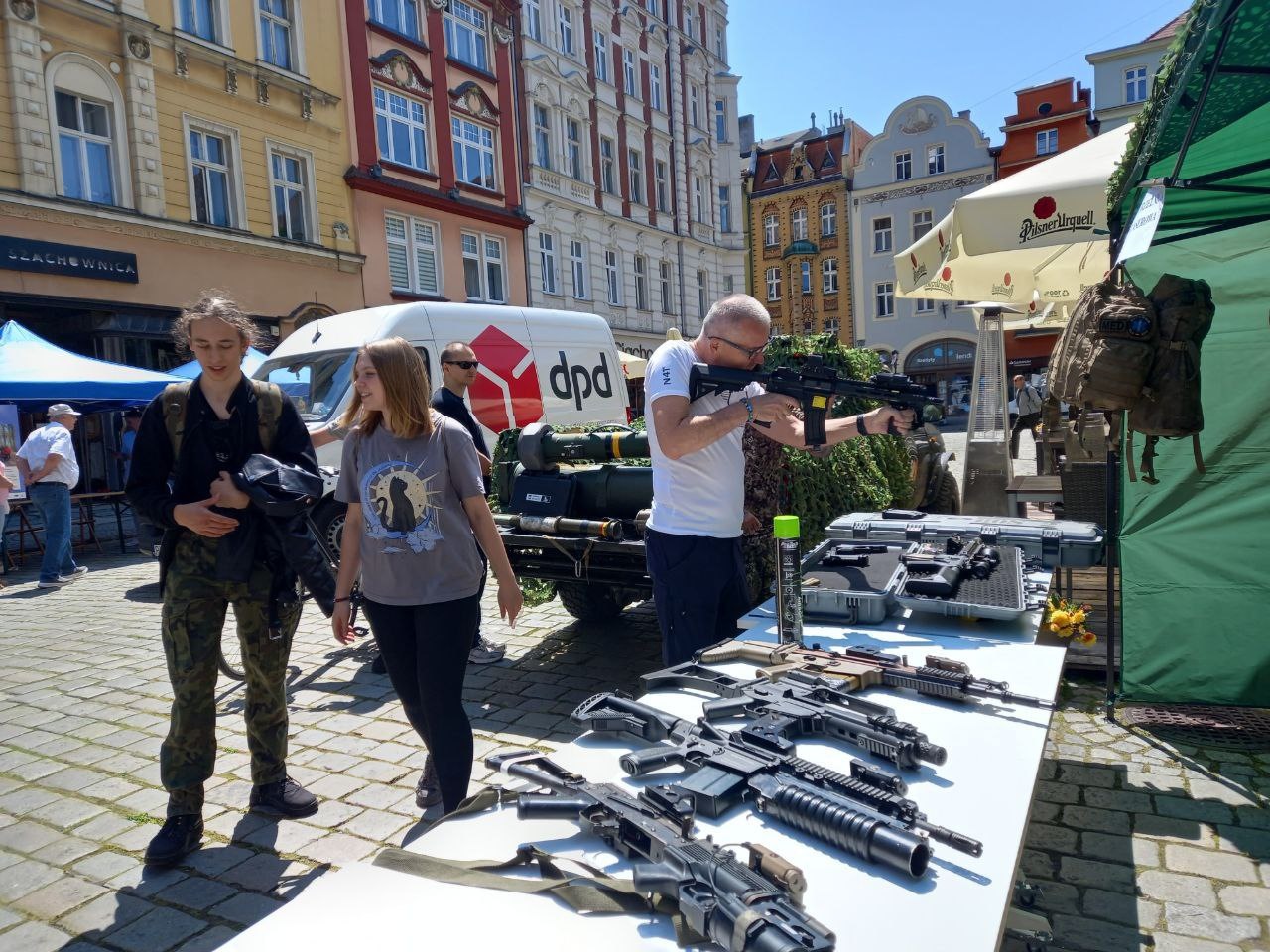
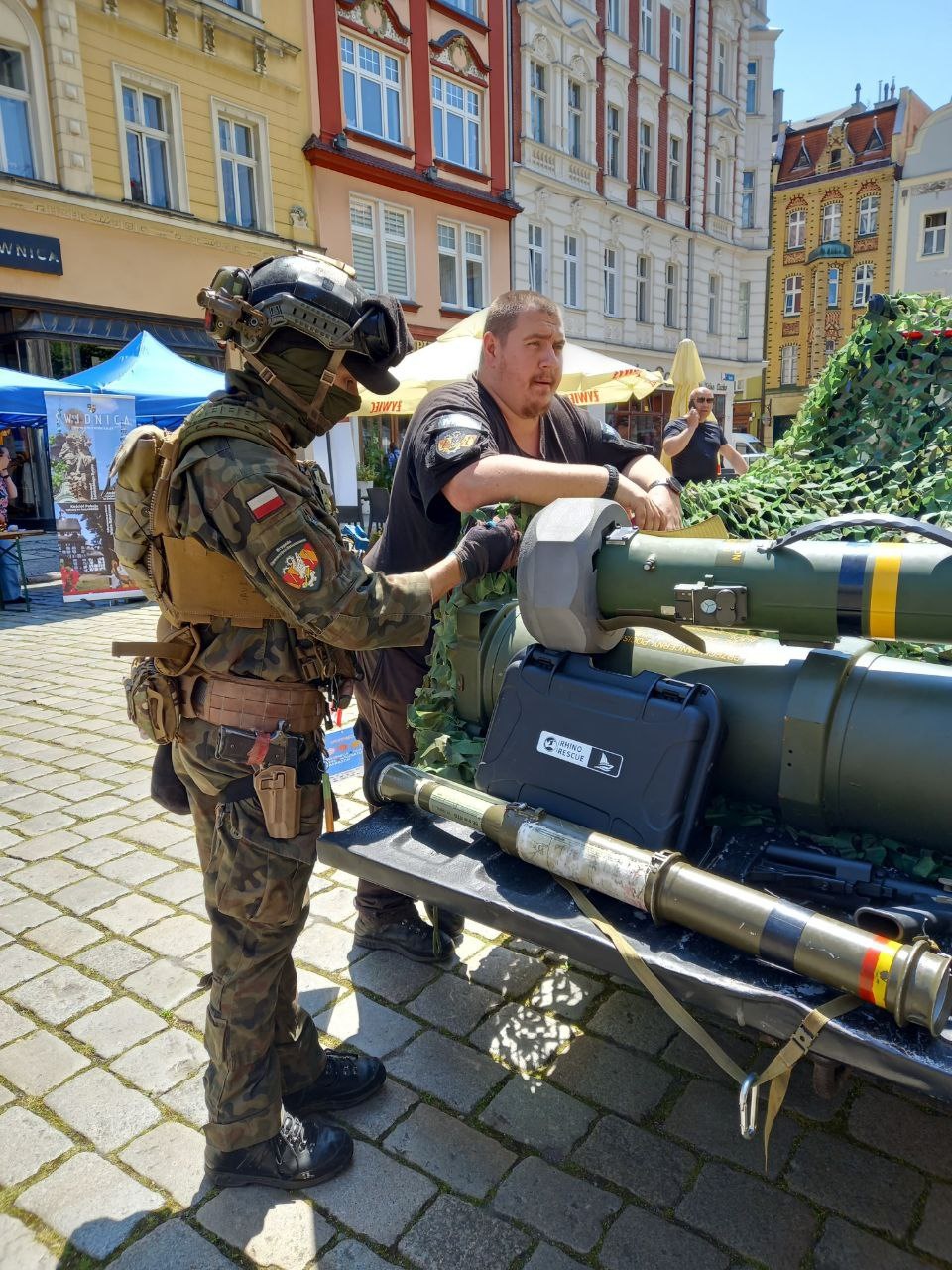
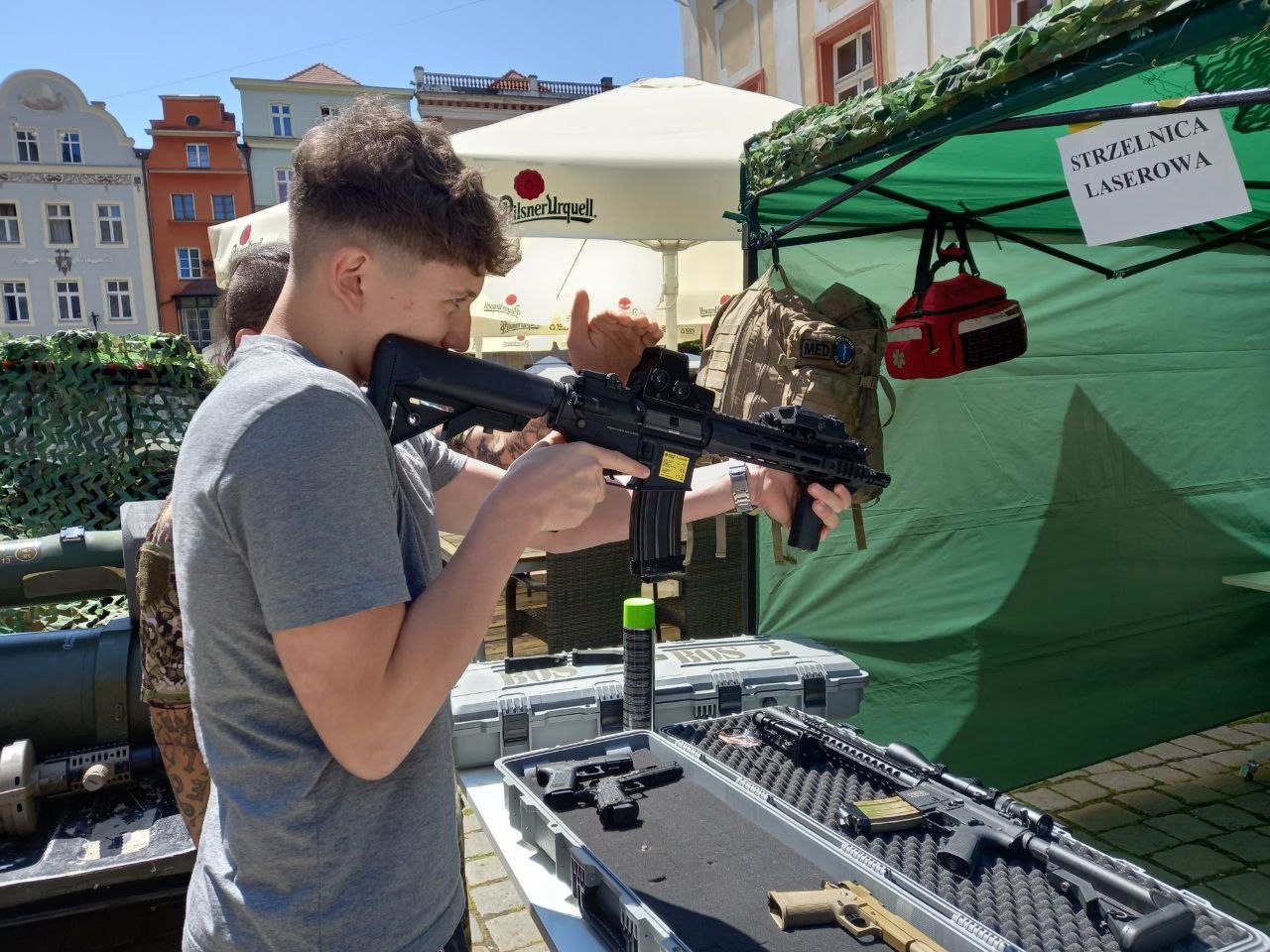
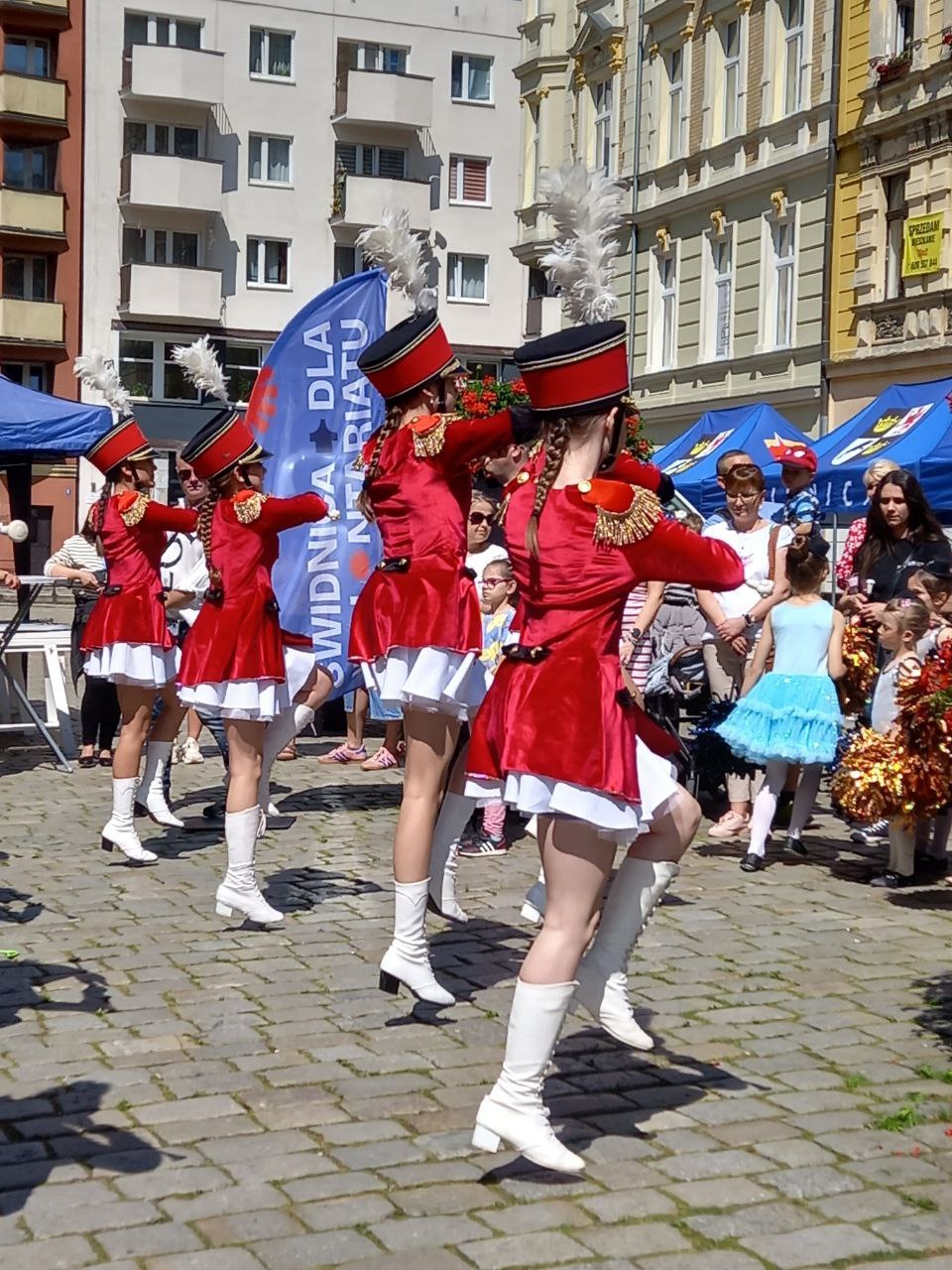
The second Volunteer Fair in Świdnica took place in the market square and the Municipal Centre for Supporting Initiatives. Its date, 13 June 2025, is confirmed by the announcement from Fundacja Ładne Historie, a local partner. The fair was part of the Świdnica for Volunteering project running from 2024 to 2026. [8]
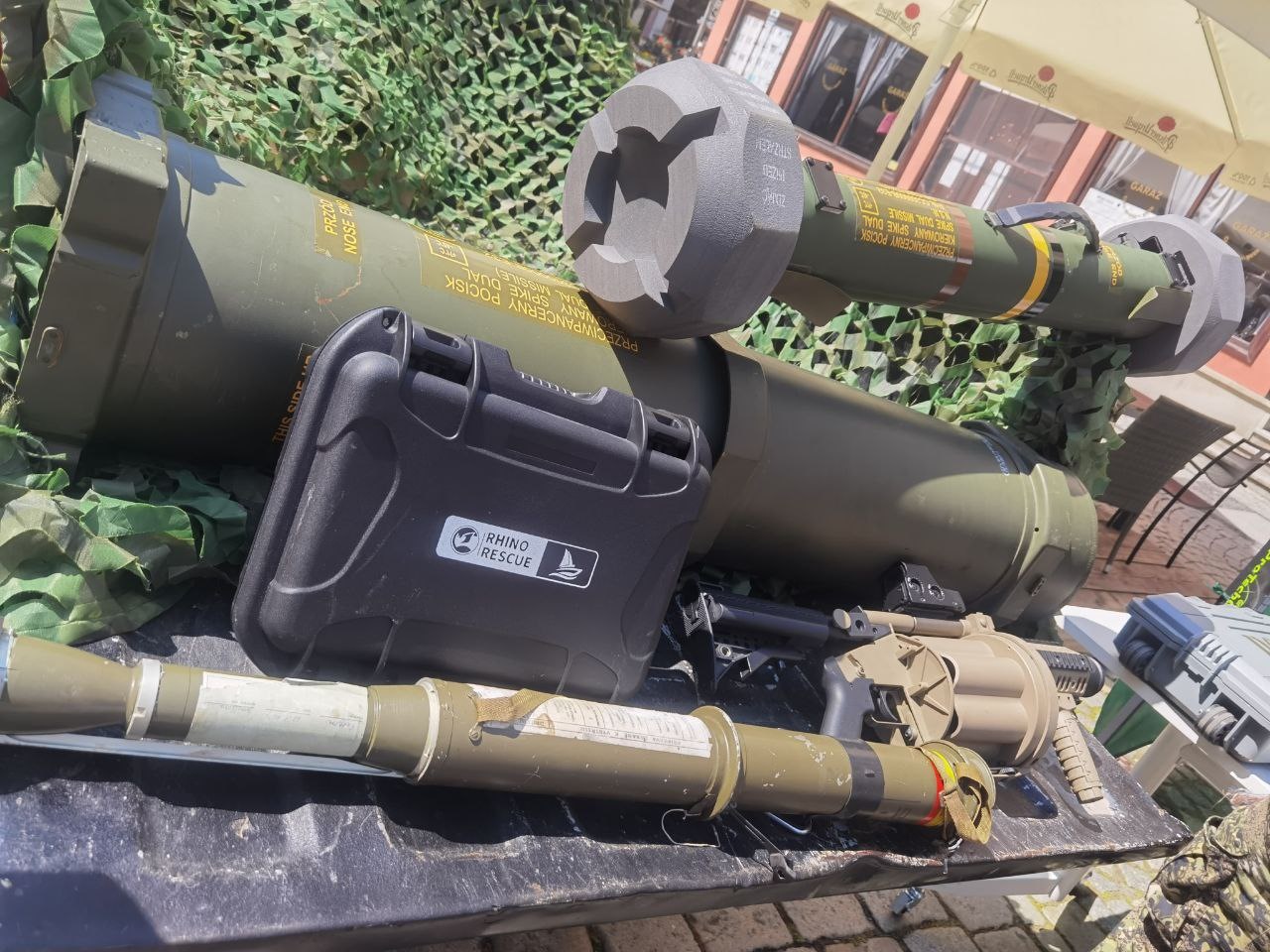
According to the Association’s supplied account, Just Do It presented Crisis Volunteer, discussed rapid assistance in emergencies and organised first-aid exercises. A laser shooting range was among the attractions. The supplied photographs show the stand, participants and demonstration equipment, as well as the atmosphere of a public city event.
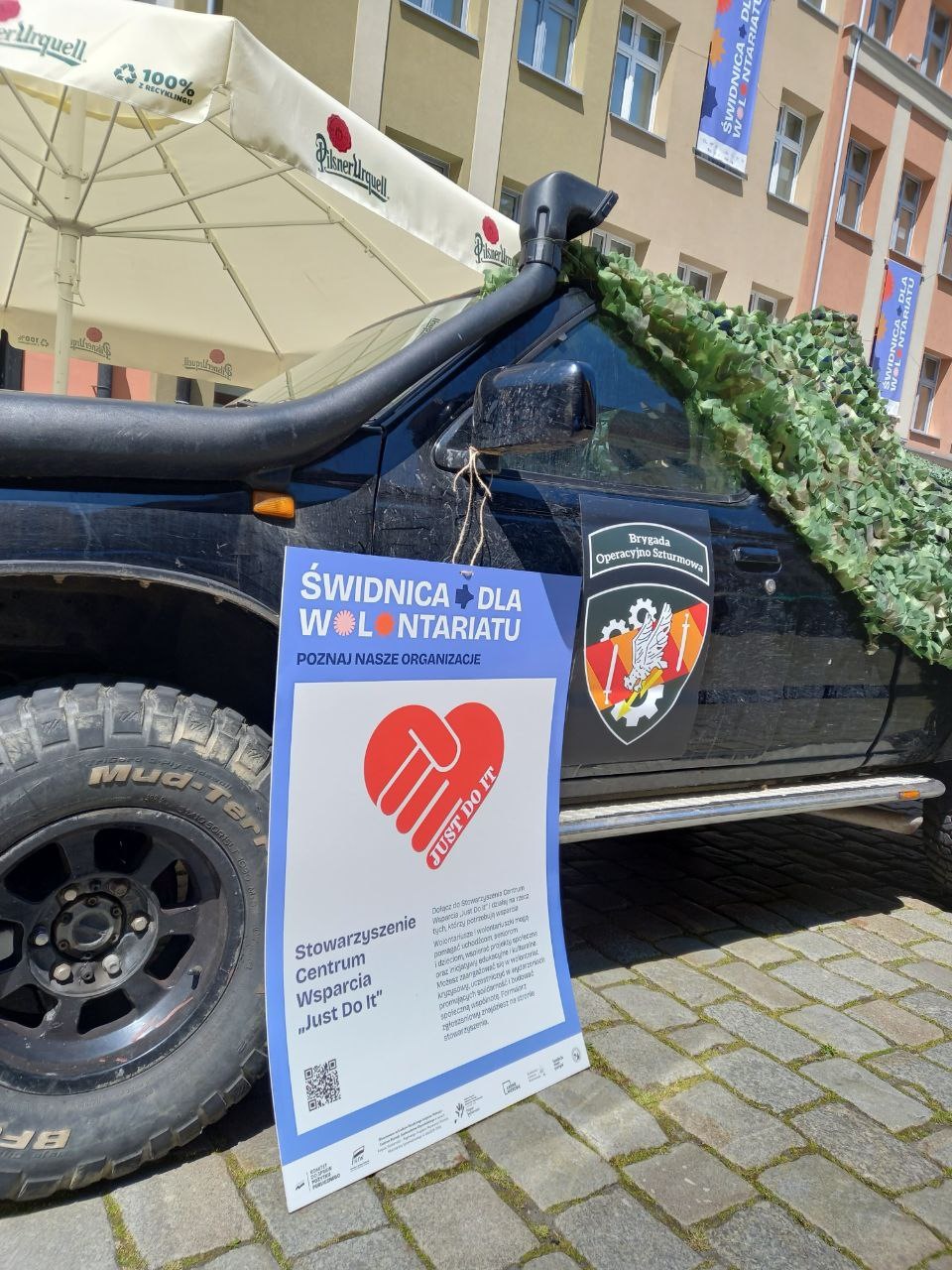
Direct contact matters at events like this. A resident need not already know the programme or understand the organisation’s structure. They can approach, ask a question and find out whether there is a suitable way to participate. For an organisation, this reaches beyond people already interested in its work.
Photographs of the laser range should be understood as an educational demonstration. They do not document combat. From a volunteering perspective, the important question is whether initial interest leads to further learning, an understanding of safety and an informed choice about one’s role.
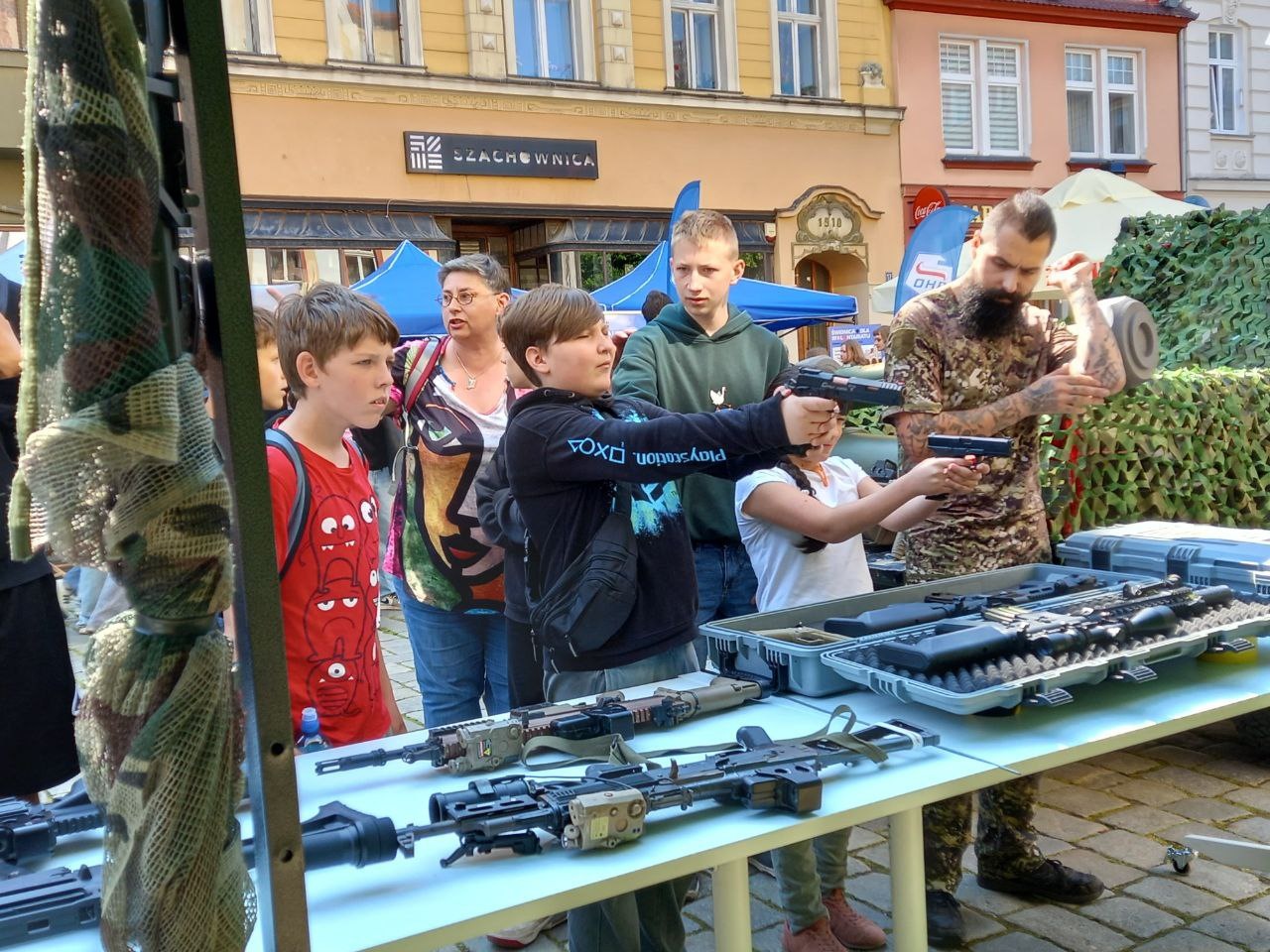
The fair also illustrates that community resilience is developed beyond expert conferences. It begins in conversations in a market square, first exercises and contact between an instructor and someone who had never considered volunteering. International ambition has value when it remains connected to such encounters.
Training and demonstrations as stages of the same work
The service catalogue also lists a Volunteer Training Programme with an edition dated 10 June–8 September 2025. Its description includes organisational values, communication with people in crisis, safety, empathy, cultural diversity and task-specific practice, delivered in person or online. A public service listing is not a graduation register, but it documents volunteer induction as a distinct process. [20]
This complements the Świdnica fair. A stand may attract interest within minutes; preparation for continuing service needs a different rhythm. Volunteers need an explanation of their role, contact with a coordinator and opportunities to ask questions. A public event can begin that pathway rather than constitute its only stage.
The report published on 26 May 2025 and updated in September describes BOSPoland training cooperation, bleeding simulators and teamwork under pressure. Further courses, school and public-office programmes and mobile training teams are presented as intended developments. Distinguishing reported workshops from future plans shows both completed work and ambition. [22]
2025–2026. A digital association: decisions independent of location
A dispersed community needs tools that allow work without requiring everyone to meet physically. The 2025 interview already described Just Do It’s own mobile application, online meetings and faster decision-making. [1, 2]
According to information provided by its President, the organisation developed a fully automated system for online assemblies and voting. It is intended to connect members regardless of country or region, shorten the path from an idea to a resolution, and facilitate implementation. This is an element of its management model as described by the leadership.
The President presents Just Do It as the first NGO in Poland to introduce such a solution. The reviewed materials do not establish priority across the entire Polish NGO sector. Its achievement can therefore be described as implementing its own integrated system, while the claim of being first must be attributed to the organisation rather than reported as an independently verified record.
The system’s value does not depend solely on who came first. In practice, participation for members far from the headquarters, reduced travel costs and continuity matter. For an international community, this concerns access to shared decision-making as well as convenience.
Automation does not mean making decisions instead of members. Its proper purpose is supporting the process: distributing materials, collecting votes and recording results. Responsibility for resolutions remains with people. This combination of technology and accountability gives digital governance its meaning.
Shared decisions begin with access to participation
The public volunteer form asks about motivation, experience, skills, available time and remote-work possibilities. Applicants can indicate events, content creation, administration, mentoring or training. It recommends completing the declaration in the volunteer’s native language. This offers a concrete picture of an organisation seeking to match different forms of involvement with participants’ circumstances. [24]
In an international team, participation cannot depend entirely on reaching headquarters on a particular day. Someone working shifts, living abroad or caring for family may have valuable knowledge and limited time. Remote tools can accommodate that contribution if materials arrive in time and the process remains comprehensible.
Voting software is only one part of shared decision-making. A member needs to understand the proposal and its consequences. Organisational effectiveness is not simply the speed or number of resolutions adopted. It also involves answers before voting and a record of the reasoning afterwards. This is a broader meaning of digital participation than an online form alone.
NGO Cyfrowo: turning organisational experience into support for others
Autumn 2026 brought a further direction: helping other organisations develop digitally. A MapujPomoc announcement describes the NGO Cyfrowo pilot and two free places for Ukrainian organisations selected after needs assessment. It lists websites, visual identity, domains and email, document tools, communication and online meetings. The announcement covers 21 October–31 December 2026. [27]
Applications use a form, needs questionnaire and brief. Support is intended to depend on each organisation’s circumstances, rather than an identical package. The pilot therefore describes diagnosis and selection of work. Two free places do not constitute unconditional admission for every applicant. [27]
For a small association, digital development can be an organisational problem before it is a technical one. Who receives a message? Where is the current document? Who retains access when a coordinator changes? A domain and organised email cannot solve everything, but can reduce dependence on one person’s private account. This infrastructure rarely appears in event photographs.
Within Just Do It’s history, the initiative moves from using tools internally towards offering support to others. Its eventual value can be assessed through organisations’ ability to maintain solutions independently and communicate more easily. The number of websites launched matters less than whether the people they serve can continue their work.
From Vice President to President: continuity of responsibility
Publications from 2024 and 2025 identify Ivan-Oleksandr Yakymiv as Vice President. In TRUTH’s first issue in 2026, he signs the manifesto as President. A public service presenting registry information lists his presidency from 19 January 2026. Registry entries and publications clarify the transition without inventing an undocumented election date. [1, 3–5]
His profile in this story combines the roles of co-founder, organiser and initiator of specialised structures. Initially, the task was to start assistance; later it involved sustaining a community, creating conditions for experts to work and connecting initiatives through a common strategic direction.
Becoming President brings responsibilities beyond representation. A growing structure requires balancing projects, setting priorities and ensuring that new institutes remain connected to the original mission. An increase in names and units alone does not demonstrate increased social impact.
Michael Laitman and a personal foundation for leadership
In the account supplied for this feature, Ivan-Oleksandr Yakymiv emphasises that throughout his journey—from the original idea, through management as Vice President, to the presidency—he has drawn on advice from Michael Laitman, whom he regards as a spiritual adviser. This is the President’s personal testimony about the influences shaping his approach.
TRUTH’s first issue contains a related account. Page 9 describes Laitman as an Honorary Ambassador, refers to his guidance on strategy and management, and identifies cooperation with the Bnei Baruch Kabbalah Academy. The Association’s public website also publishes texts referring to his teachings. [5, p. 9; 9]
In this context, Kabbalah appears as a source of reflection on relationships, responsibility and moving beyond self-interest. For Yakymiv, the relevant guidance concerns perspective, mutual respect and the effects of decisions on other people. The significance of such a relationship can be described without assigning the adviser a formal board position.
A leader’s personal inspiration should be distinguished from access to assistance. Spiritual beliefs may influence motivation, while an account of a support organisation remains centred on people’s needs and responsibility for its work. This is where stated values become observable practice.
2026. Why four institutes were created
TRUTH’s first issue presents four institutes as pillars of the developing Just Do It environment: CODI, IBRO, ISDIC and IPHI. Each addresses a problem encountered in civic work: information quality, crisis preparedness, international cooperation and health. [5]
Their creation can be understood as an attempt to organise knowledge and responsibility. In a small initiative, personal relationships resolve many issues. A larger organisation needs teams able to maintain standards, develop programmes and transfer experience to new participants.
The institutes are described as units within the Association. The word institute does not automatically establish the status of a state research institution, separate legal personality or authority to award qualifications. Here, it primarily describes the specialisation of civic and expert work.
Institute autonomy and shared accountability
The public transformation statement says the institutes were established by board resolutions and work under their own concepts and internal rules. They are described as units with leadership and programme autonomy that also advise the Association’s board. Specialisation is intended to coexist with a shared mission and cooperation. This is the organisation’s account of its own model. [25]
Practically, a health programme should not be evaluated using precisely the same subject criteria as information-literacy training. Each requires relevant expertise. Funding, accountability and reporting outcomes must nevertheless remain comprehensible across the organisation. Autonomy is useful when teams know what they can decide and what requires collective agreement.
The arrangement also supports institutional memory. If all knowledge stays on one person’s phone, a coordinator’s departure can interrupt a project. Materials, procedures, contacts and defined roles enable successors to continue. This gives the institute label substance: a commitment to develop and transfer knowledge rather than present it once.
CODI: resilience starts with evaluating information
CODI, the Institute for Research on Information and Disinformation, addresses situations in which false information can alter a health decision, cause panic or undermine trust in assistance. Its flagship initiative is CODI-DW—Combating Disinformation in the Digital World. [5, pp. 10–11]
The educational programme covers disinformation mechanisms, manipulation, digital platforms, AI, critical thinking and ethics. Its purpose is to develop the ability to assess content, rather than merely provide a ready-made list of true and false stories. [10]
The magazine uses the metaphor of a cognitive shield. Its most useful interpretation is straightforward: a person should be able to pause before sharing unverified information, recognise missing evidence and look for a source. This is relevant to volunteers, teachers, journalists and managers alike.
A programme that makes information a subject of practice
CODI-DW’s public curriculum moves from definitions of information disorder through its mechanisms, technologies and critical thinking towards mitigation. It distinguishes misinformation, disinformation and malinformation, and examines algorithms, attention economics and psychology. Learners are meant to understand both a message and the conditions under which it is produced and distributed. [28]
The separate Scenario-Based Learning module describes situations inspired by reality, requiring assessment of context, evidence, ethical consequences and responses under uncertainty. This is a teaching method: participants practise reasoning rather than only listening to a lecture. [30]
For a civic volunteer, the format can mean moving from an impression towards an explainable conclusion. An illustrative exercise might give a team conflicting reports about aid availability. They would identify what is confirmed, whom to ask and what to communicate before further information arrives. This illustrates the method rather than claiming that a particular workshop occurred.
The benefit is an opportunity to make mistakes without real consequences for a beneficiary. A trainer can revisit a decision, compare arguments and identify missing information. Participants learn both an answer and the route towards it. That route can remain useful when tools, platforms and misleading narratives change.
From checking a source to communicating responsibly
The critical-thinking module emphasises credibility, bias and distinguishing evidence from persuasive narratives. It also examines the moment of reaction: learners should be able to interrupt automatic sharing of emotionally charged information and investigate its basis. [29]
The ethics module frames counter-disinformation work around proportionality, transparency and human rights. Protecting information should not undermine trust or freedom of expression. This matters for an institute connecting civic education with technological analysis. [31]
For an assistance organisation, these abilities meet in an ordinary task: writing an announcement. A project notice must explain eligibility, the offer and what still requires assessment. An expansive promise may attract attention while creating false expectations. Communication therefore becomes part of responsibility for assistance rather than a promotional extra.
The resilience module identifies trust, media literacy, institutional transparency and cross-sector cooperation. Its perspective is long term: a resilient community retains the capacity to understand and act even when every misleading item cannot immediately be eliminated. [32]
CODI leadership: three areas of expertise and shared programme responsibility
The current institute ecosystem description on ISDIC’s website identifies Daniel Koh as CODI’s Director, Kathrin G. Kind as Deputy Director for Programmes and Robbert Zijlstra as Deputy Director for Operations. These institute appointments should be distinguished from roles within the CODI-DW programme. One person may guide an institute while also acting as a trainer, assessment lead or legal adviser in a particular project.
Daniel Koh — CODI Director

Daniel Koh connects education, analytics and entrepreneurship. CODI-DW’s public team profile describes him as a Singapore-based data scientist, educator and entrepreneur leading Data Chord. As Project Lead and trainer, he contributes the discipline of working with evidence: defining a problem, examining available information and then selecting tools. In disinformation education, this means teaching methods of testing claims rather than merely delivering ready-made answers.
Kathrin G. Kind — programmes and assessment

Kathrin G. Kind, identified in the programme as Assessor Lead and trainer, brings experience in artificial intelligence and responsible technological development. Programme leadership matters to educational consistency: learning goals, exercises and assessment should develop the same capabilities. Interest in technology does not remove the need to ask whether learners can apply knowledge outside the classroom and understand the limits of a tool.
Robbert Zijlstra — AI law and operations
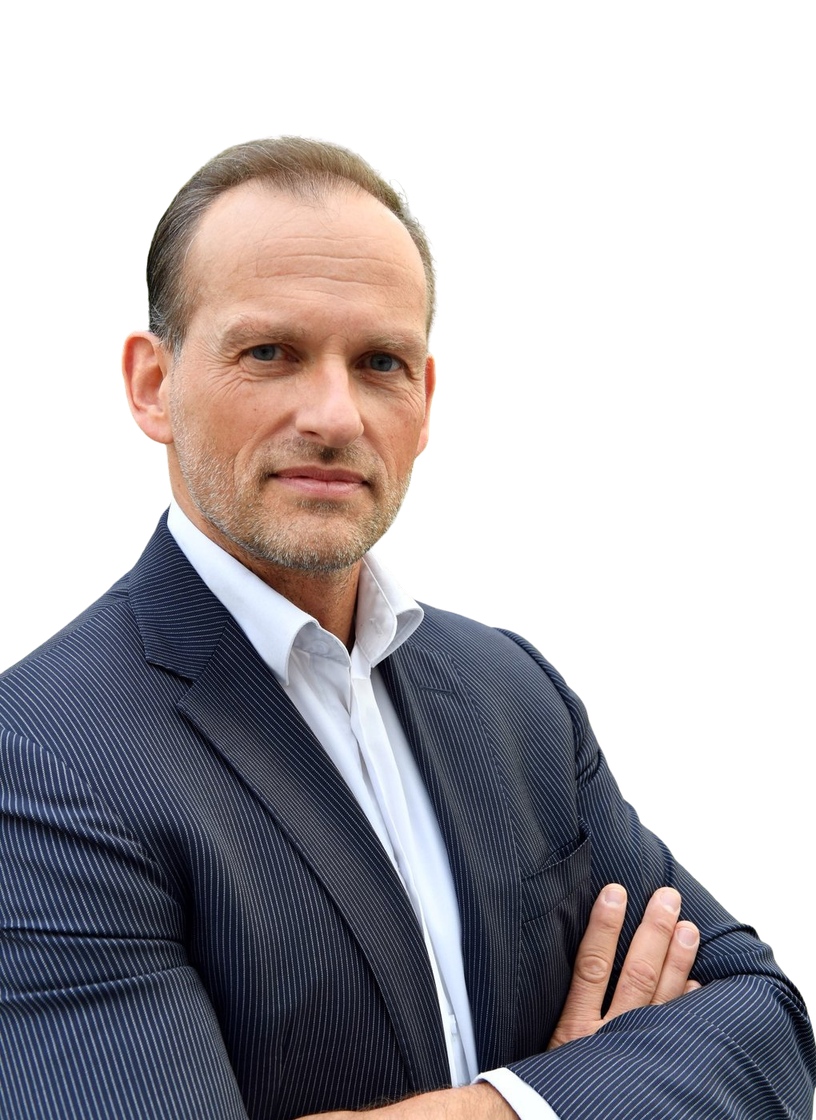
Robbert Zijlstra is presented as an AI governance and intellectual-property specialist and founder of IP/AI Growth. Within CODI-DW he is Legal Counsel and trainer. His involvement connects technological knowledge with responsibility for data, content and analytical results. Operationally, an international programme requires both useful learning material and organised cooperation that recognises legal risks.
Ivan-Oleksandr Yakymiv — programme administration

Ivan-Oleksandr Yakymiv is listed as Administration Lead. This forms a bridge between substantive work and the Association’s organisational foundation: meetings, communication, partnerships and continuity. Accounts of achievements should preserve that division. An international programme is a team effort, and its roles are not interchangeable titles.
The ambassador network may contribute perspectives from different disciplines but does not replace institute management or programme authors. Distinguishing a consulting expert, a course trainer and an institute manager helps readers understand responsibility.
Profile and structure sources: [34] [41].
IBRO: from a project to civic preparedness
IBRO, the Institute of Civic Security and Rescue, develops the Just Do It–BOSPoland collaboration. TRUTH’s first issue describes it as an internal unit preparing instructors and volunteers and organising training standards. [5, pp. 14–17]
The magazine identifies five structural areas: tactical training; rescue and combat medicine; crisis management and volunteering; standards and certification; and operations and logistics. This organisational model does not mean that everyone attending an open workshop receives training of the same difficulty.
For IBRO’s civic purpose, the central challenge is translating knowledge into appropriate civilian education. Activities for children, adult volunteers and security professionals require different designs. Quality depends on suitability, rather than intensity alone.
IBRO’s full leadership: more than a director and one deputy
IBRO’s current structure page names Kamil Sadzik as institute Director and BOSPoland Commandant, alongside four deputies. Anna Kempa and Paweł Szpunar hold programme appointments; Maciej Gawłowski and Kamil Wajdzik hold operational appointments. This adds an important layer to the magazine’s account: a substantial training programme needs both educational design and the organisational conditions for delivery.
Kamil Sadzik — IBRO Director

The institute’s profile presents Kamil Sadzik as a Polish Armed Forces veteran, instructor and specialist in survival, tactical rescue and intervention techniques. Its description includes Stop the Bleed, SERE, self-defence and safety, alongside education for young people, schools, Youth Fire Brigades and local communities. These are institute and BOSPoland descriptions, rather than an editorial certification of his qualifications.
Anna Kempa — Deputy Director for Programmes
Anna Kempa is Deputy Director for Programmes. Alongside Paweł Szpunar, she represents programme preparation within the institute’s leadership. The current public page confirms her role but does not provide a detailed biography or portrait.
Paweł Szpunar — Deputy Director for Programmes
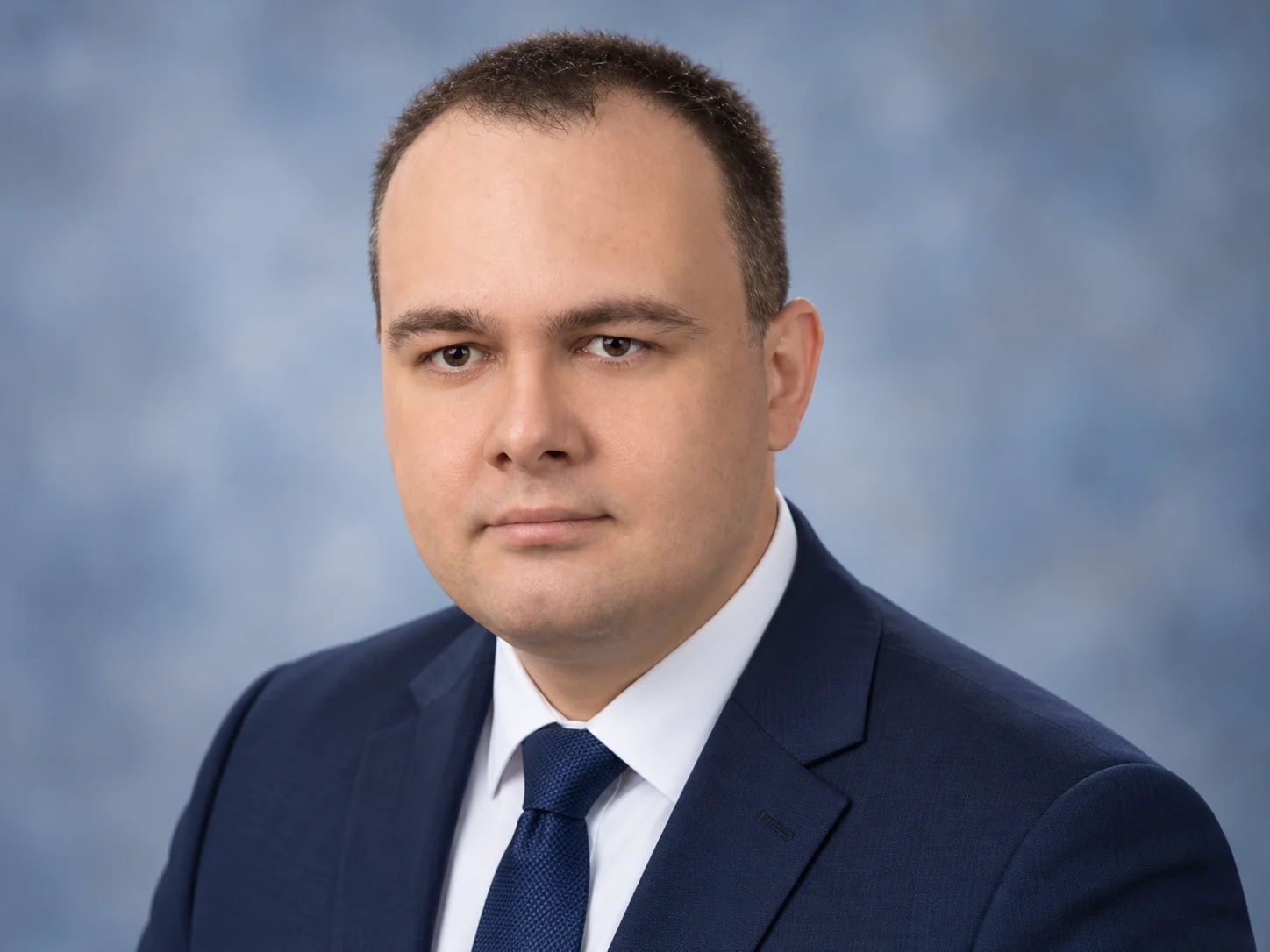
Paweł Szpunar combines his programme appointment with the perspective on preparing volunteers for difficult conditions described in TRUTH. His role helps distinguish individual experience from a programme that successive instructors can deliver consistently. Such a programme needs a defined audience, intended skills and clear boundaries of responsibility.
Maciej Gawłowski — Deputy Director for Operations

IBRO’s current leadership presentation identifies Maciej Gawłowski as Deputy Director for Operations and publishes his named portrait. This belongs to the delivery side of the structure: connecting the agreed direction with work organisation and readiness to carry out tasks.
Kamil Wajdzik — Deputy Director for Operations
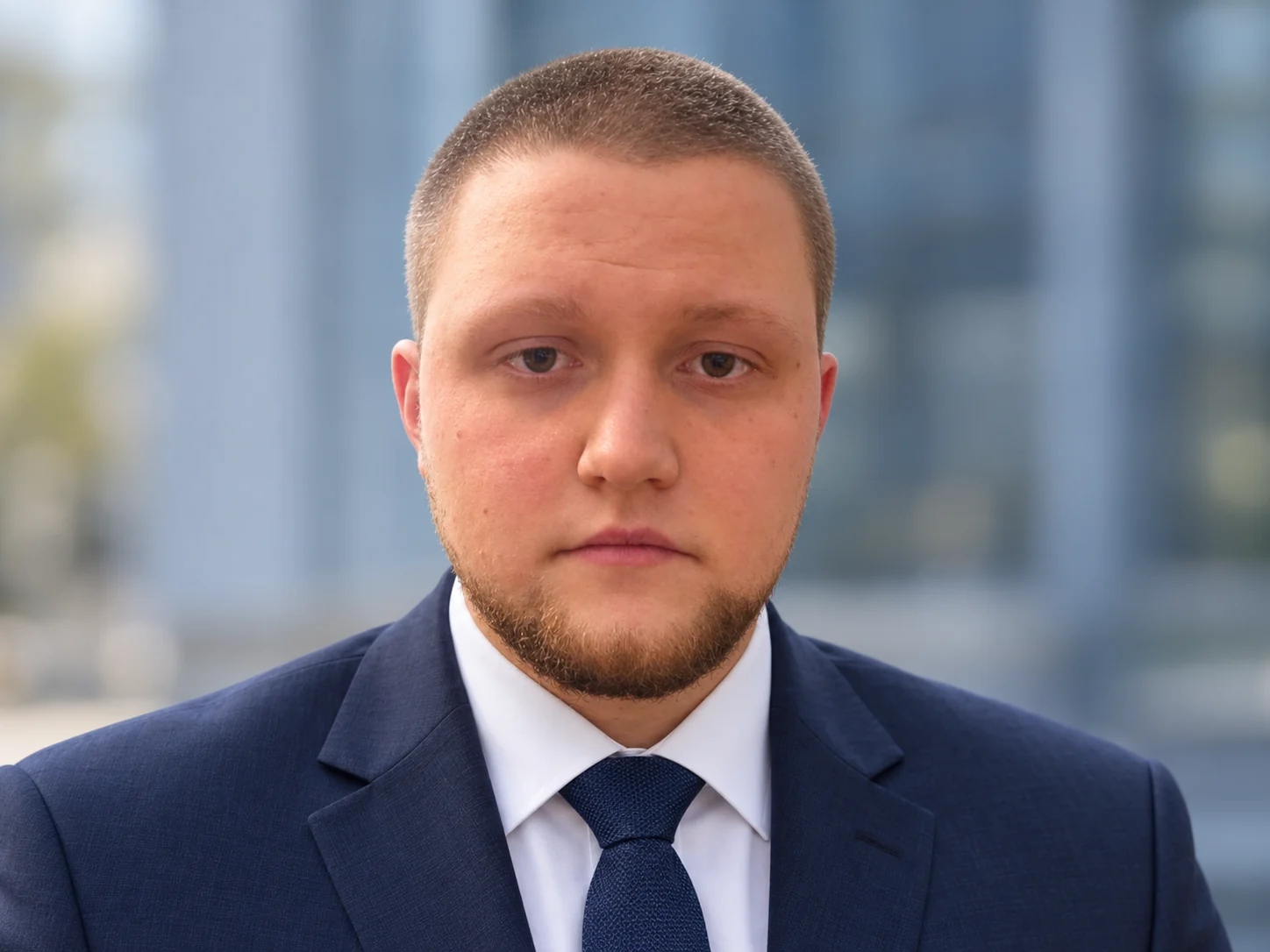
Kamil Wajdzik is also listed as Deputy Director for Operations, with an individual portrait. The leadership page confirms his appointment without providing a detailed biography. It therefore does not justify adding particular deployments, military ranks or personal service histories. Showing the full leadership should go hand in hand with precision about the available information.
Five teams and an advisory council: dividing responsibilities
The current structure names the Rescue Team, Security Team, Rescue Logistics Team, Training and Exercises Team, and Crisis Intervention Team. Rescue concerns assistance and evacuation; security covers threat analysis and prevention; logistics encompasses supplies, transport and equipment storage; training develops skills through exercises; crisis intervention concerns coordinating responses.
A Programme Council of external experts is also intended to support substantive direction. The page states that its detailed membership and working arrangements are established by a separate Director’s order following consultation with the Association’s board. Membership of the ambassador network should therefore not be treated as automatic membership of that council. The institute also notes that staffing can develop in stages. Its structure describes responsibilities and intended development rather than proving that every team is fully staffed simultaneously.
Roles within teams: from responder to exercise coordinator
IBRO’s public structure goes below team names. Rescue includes a leader, senior responder, responder and junior responder. Security lists a leader, specialist, threat analyst and coordinator. Logistics includes leadership, procurement, transport and equipment storage. Training lists a manager, rescue and security instructors and an exercise coordinator. Crisis intervention combines leadership, coordination, crisis-management expertise and situation analysis. These are organisational roles; the page does not publish a complete named roster, and these labels do not establish individual professional licences.
This division makes it possible to describe a preparation process: identifying needs, defining scope, securing resources, conducting an exercise and reviewing findings. Each stage can fail for a different reason. A programme without equipment may not be delivered; equipment without appropriate instruction does not guarantee learning; a well-run session without evaluation may not improve the next edition. This is an editorial interpretation of organisational design, rather than an account of a specific IBRO operation.
Profile and structure sources: [35].
ISDIC: turning a network into cooperation
ISDIC, the Institute of Social Diplomacy and International Cooperation, addresses how a dispersed network of experts and contacts can become a platform for shared work rather than an exchange of business cards. [5, pp. 44–45]
An older online description of organisational transformation names different deputies. This feature follows the later first issue of TRUTH, presenting the leadership described in that issue rather than claiming indefinite confirmation of every appointment. [5, 11]
Social diplomacy does not replace state diplomacy. Its domain includes civic contacts, education, culture and organisational cooperation. In this sense, ISDIC can help translate knowledge from one country into a useful project elsewhere.
Letícia Lino de Souza: social development and people-centred diplomacy

ISDIC’s current leadership presentation confirms Letícia Lino de Souza as Director. Its CV-based biography presents her as a Brazilian international-relations specialist and social entrepreneur, working on youth leadership, women’s empowerment and cooperation among public institutions, business and civil society.
The biography states that she has led Instituto Elos que Empoderam since November 2023. It also lists experience with Connect Visa Immigration, Portal Diplomatic and Confederação Nacional das Câmaras Municipais. International mobility intersects here with social development: travel, education and institutional contacts can create opportunities but require knowledge of different systems.
The profile includes volunteering with UN Volunteers Europe and Central Asia, involvement with UNODC and Instituto Jovem Exportador. These are attributed CV statements. Memberships and completed courses should be distinguished from employment within international organisations. Her relevant contribution to ISDIC is the ability to turn relationships into practical cooperation.
Farihah Mohammed: programmes informed by protection and field knowledge

Farihah Mohammed is Deputy Director for Programs. Her current biography identifies her as an independent international-development consultant based in Port of Spain, Trinidad and Tobago. Her work covers research, human rights, policy analysis, advocacy and strategic communication, particularly refugee protection, forced displacement and human trafficking.
From 2018 to 2023 she worked with UNHCR as Protection Assistant – Registration; in 2018 she was Executive Assistant to the Ambassador of Argentina in Port of Spain. The biography also records earlier work teaching Spanish. This combines institutional experience with explaining complex issues to others. Within ISDIC, that combination can support programmes beginning with actual needs rather than the appeal of a slogan.
Her education includes Global Studies, international relations, and Spanish and communication studies at the University of the West Indies. The profile lists English, Spanish and French. International cooperation requires this translation of context: experience from one country needs to be understood and adapted rather than copied mechanically.
Epaphras Gibbs: operations, communication and development

Epaphras Gibbs is Deputy Director for Operations and Development. His current biography connects organisational management, journalism and youth work. It lists coordination of Haiti’s Kenari Magazine from 2020 to 2025 and service as Editor-in-Chief of GRAN HIT HAÏTI from May 2022 to March 2025. These roles require both work with content and organisation of the processes producing it.
His profile lists studies in international relations and communication and media, USIDHR certification and negotiation training. Gibbs is also an Honorary Ambassador of the Association. His ISDIC role illustrates a route from expert networking towards delivery responsibility: maintaining contacts, coordinating people and turning agreements into next steps.
ISDIC identifies six areas: social diplomacy, international cooperation, geopolitics and analysis, intercultural and interfaith dialogue, digital diplomacy, and diasporas and transnational communities. Fellowships, a Global Ambassador Summit, reports and policy briefs are explicitly presented as development priorities. They should retain that future-oriented description: a programme plan is not evidence that successive editions have already taken place.
Phased development rather than instant scale
ISDIC’s public strategy describes four phases measured from implementation. The first six months concern foundations: leadership, a programme council, recruitment and communication. Months six to eighteen envisage building an operational core, pilots and a first geopolitical report. Subsequent phases concern exchanges, an ambassador summit, larger funding and financial sustainability. These are development assumptions, rather than a calendar of completed achievements.
Funding is also described as a model: initial Association resources followed by possible grants, donations, sponsorship, community support and expert activities. Listing these sources does not establish an award of a particular grant. It does show that the concept recognises continuity. Social diplomacy needs systematic work between meetings: preparing discussions, recording agreements, maintaining correspondence and checking that partners still share objectives.
Profile and structure sources: [36] [39] [40].
IPHI: health as a condition of resilience
IPHI, the Institute of Public Health and Innovations, brings population health into the structure. Humanitarian crises do not end when transport and shelter are secured. Their consequences also concern mental health, continuity of care, reliable information and trust in institutions. [5, pp. 46–47]
The magazine describes a sequence of identifying needs, analysing them, designing innovation and deployment. The problem must first be understood, possible responses assessed and tools selected accordingly. A technology’s novelty alone does not establish its usefulness to someone needing support.
IPHI connects thematically with the other institutes: with CODI on health disinformation, IBRO on crisis preparedness and ISDIC on cooperation and exchanging experience. The structure’s value lies in working together on specific problems, beyond having four separate identities.
Ivana Haluskova Balter: global health requires connected perspectives
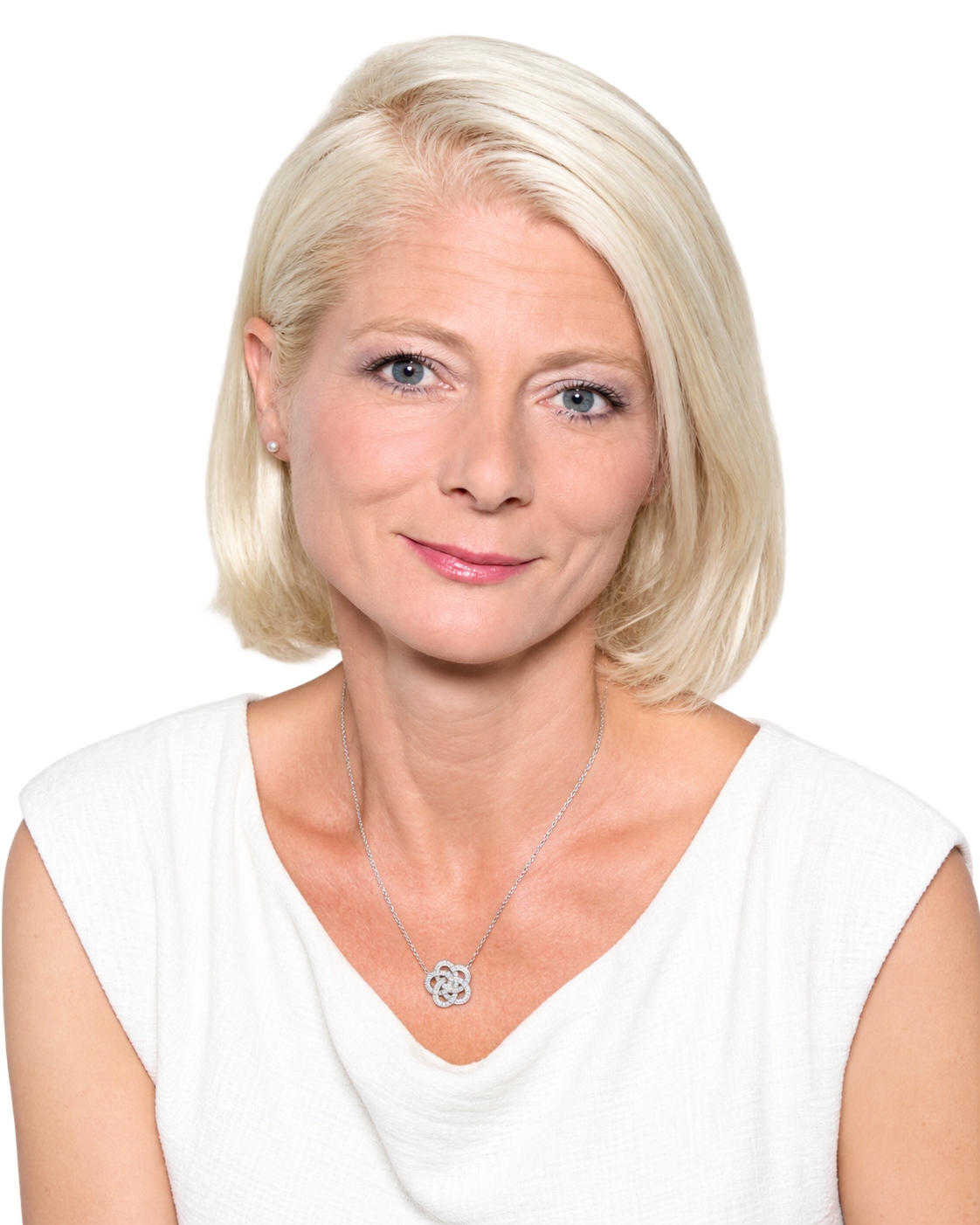
IPHI’s current leadership page presents two different responsibilities: Ivan-Oleksandr Yakymiv as President of the Association’s board and Dr Ivana Haluskova Balter as institute Director. It does not publish a list of IPHI deputies. Farihah Mohammed’s and Epaphras Gibbs’s appointments should not be transferred to IPHI: ISDIC’s current website assigns their roles to ISDIC.
The Director’s biography describes her as an international health and science consultant. It covers infectious diseases, vaccines, immunology, antimicrobial resistance, clinical research and public-health preparedness. This breadth illustrates that public health involves biological knowledge, care systems and decision-making rather than a single specialism.
According to the profile, her experience includes roles with Pfizer, Wyeth, Servier, Flamel Technologies and AZURRx, alongside advice and advocacy. The page lists executive education in health and diplomacy at the Geneva Graduate Institute and further programmes in immunology and infectious diseases. These elements explain why IPHI’s leadership connects research with communication and international cooperation.
IPHI’s fields: mental health and responsible technology
The institute’s vision includes global health and systems, humanitarian situations, equitable access, research and development, technology, mental health, education and public communication. These are programme frameworks rather than a record of completed interventions. Their common question is how knowledge can become useful to communities facing barriers.
For example, telemedicine can reduce distance without automatically resolving inadequate internet access, a lack of privacy or language support. Data analysis can identify needs but requires protection for the people concerned. Health education becomes more useful when it considers accessible language and local conditions. These are editorial examples illustrating the proposed approach, not claims about services already delivered by IPHI.
The published model moves from recognising signals through analysis and design to implementation with partners. Ambassadors and local organisations would contribute knowledge of needs; specialists would interpret evidence; teams would develop responses; partners would support delivery and assessment. Specific timetables, programmes and measures of effectiveness depend on further planning. Distinguishing vision from delivery describes institutional ambition without presenting future outcomes as completed achievements.
Profile and structure sources: [37] [38].
Honorary Ambassadors: the Association’s expert backbone
According to information provided by the President, the ambassadors’ council was created on Ivan-Oleksandr Yakymiv’s initiative. Its purpose was to involve people from different countries whose knowledge, experience and contacts could support the Association’s development. The public network covers specialisms ranging from education and health to technology, security and communication. [12]
Expert backbone is an appropriate description of the function to which this network aspires. An organisation needs access to knowledge that cannot all be concentrated in one small local team.
TRUTH’s first issue presents Roy Rillera Marzo in public health, research and education; Kathrin G. Kind in responsible AI; Daniel Koh in data science; and Robbert Zijlstra in AI governance and intellectual property. These profiles illustrate connections between ambassadors’ expertise and institute programmes. [5, pp. 18–20, 27–28, 38–39]
Ryosuke Nakajima brings the relationship between education and professional experience through ProfBridge. Jess Toft contributes a perspective on neuro-inclusive design, Dale Yeager on analysis and security, and Graciela de Oto on women’s entrepreneurship. These different contributions can widen the Association’s range of responses. [5, pp. 32–36, 42–43]
Not everyone featured in the magazine holds a management role, and not every collaboration constitutes membership of the Association’s governing bodies. An ambassador may advise, introduce contacts, lead discussions or develop a programme; an institute director has responsibility for its direction. An honorary title should not obscure actual duties.
The council’s most important measure is therefore what reaches people through its knowledge: a course, consultation, publication, partnership or solution. International reach becomes a resource when it enables work that one team could not perform alone.
The expert council and journalism award are distinct initiatives
The Association’s Honorary Ambassadors should not be confused with candidates for the Ambassador TRUTH journalism award. The competition website describes the first 2027 edition as recognition of journalists, creators and educators, with jury and audience nominations followed by recipient selection. A candidate listing does not establish membership of the expert council or endorsement of all Association activities. [33]
This distinction clarifies roles around Just Do It and TRUTH. Some people contribute to the organisation’s knowledge network; others are featured for journalism, while others manage institutes. Sharing the word ambassador does not make these relationships one position. Readers should understand why a person appears and what their involvement actually concerns.
TRUTH Magazine: knowledge beyond the training room
TRUTH’s first issue represents another stage. It describes projects and people while connecting direct assistance with reflection on contemporary threats. Volunteering, information resilience, health, social diplomacy and technological development appear in one publication. [5]
Publishing can extend the life of knowledge. A meeting ends after a few hours; a recorded conversation or organised article can help someone who was not there. It also creates space for arguments and sources that cannot be explored in a brief promotional message.
An organisation’s publication must make its relationship with the projects it covers clear. Readers should understand when they are receiving a participant’s account, a leadership statement or editorial analysis. Such transparency supports credibility.
Numbers tell a story only when their meaning is clear
The 2025 interview gives figures of 81,000 members, 560 volunteers across 20 EU countries and more than 300 registrations for crisis-volunteer training. These should be attributed to that publication, rather than automatically treated as the position in November 2026. [1, 2]
TRUTH’s first issue contains different measures of training reach: more than 10,000 people in the joint-initiative account and more than 27,000 in the broader description of BOS training between 2023 and 2026. These cannot simply be added. They may concern different periods, programmes and definitions of participation. [5, pp. 6–8, 15]
A consistent assessment would require reporting unique participants, event numbers, training duration and how skills were evaluated. The absence of such a consolidated statement in the reviewed materials does not erase the work undertaken. It sets the limits of what can responsibly be concluded from the available figures.
Recognising civic work: the token experiment
The JustDoItCoin description, published on 5 February 2025 and updated in September, presents a voluntary recognition programme. The Association describes points according to activity and a record on the participant’s account, identifies the BEP-20 standard and permits transfers. These are programme rules rather than promises of price, profit or market liquidity. [23]
The idea addresses a familiar organisational question: how can work invisible in photographs be recognised? Someone prepared materials, organised a participant list or translated information. Records may make that contribution visible, but should not replace discussion of quality or reduce every task to a single simplistic score.
Similar care applies to public course counters. The programme catalogue lists first aid, crisis-management instructor training and a six-week crisis-volunteering course. A participation counter alone does not explain whether it measures registration, starting, completion or unique individuals. Recognising this distinction is more useful to readers than adding impressive totals. [26]
What connects the stages
One theme connects refugee assistance with the institutes: increasing people’s ability to act. A newcomer needs access to information and services. A volunteer needs preparation. An expert needs a setting in which knowledge can be applied. An organisation needs a decision-making process that works across geographical borders.
Just Do It’s chronology shows responses expanding: direct assistance followed by integration and volunteering, then international cooperation, digital tools and specialist structures. These were not necessarily separate stages completed one after another; successive layers developed alongside earlier work.
The model’s potential strength lies in connecting disciplines. A person in crisis rarely needs only one service, just as an organisation supporting a community rarely needs only one kind of knowledge. Security, health, information and cooperation are connected in the lives of the people it aims to serve.
The Association’s future depends on maintaining the connection between an expanding structure and concrete needs. An institute, expert council, application or magazine matters when it helps someone understand a situation, regain independence or support others responsibly. In that sense, Just Do It remains a relevant invitation: an idea must ultimately become action.
Timeline
- March 2022 — Initiative begins with eight people from Poland and Ukraine, according to the interview and organisational accounts.
- 18 August 2022 — Association registered under KRS 0000983480.
- 7 February 2024 — Global Summit on Social Impact in Warsaw; JDI’s account published on 1 April 2024.
- 2024–2025 — Development of crisis volunteering and BOSPoland cooperation.
- March–May 2025 — Publications concerning the Alliance for Good and Business & Philanthropy Forum conversation.
- 13 June 2025 — Second Volunteer Fair in Świdnica; Just Do It’s attendance documented by the supplied account and photographs.
- 19 January 2026 — Start of Yakymiv’s presidency as listed in public registry information.
- 2026 — TRUTH’s first issue presents CODI, IBRO, ISDIC, IPHI and their leadership.
Editorial note: sources establish the development of digital tools and online meetings but do not establish priority across all Polish NGOs. Honorary titles are not presented as state appointments, and programme descriptions are not treated as evidence of accreditation. Leadership biographies cover the roles relevant to this feature; unverified prestige claims and superlatives have been omitted. Spiritual guidance is attributed to the President’s account. Archival photographs illustrate the events described.
Gallery: Świdnica, 13 June 2025

Contact and further information
Just Do It Support Center Association
centrum-wsparcia.pl ↗
info@centrum-wsparcia.pl
Sources and background
- Przekazany PDF: „Alianse for Good: Rozmowa z Ivanem-Ołeksandrem Yakymivem, Wiceprezesem SCA JUST DO IT”, 8 stron; publikacja 11.03.2025, aktualizacja 20.07.2025. ↗
- Przekazany PDF i wersja internetowa: „Just Do It Support Center Association: Help Is Here”, B&P Forum, 26.05.2025, 8 stron. ↗
- Przekazany PDF: „ŚWIATOWY SZCZYT W SPRAWIE WPŁYWU SPOŁECZNEGO 2024”, 13 stron, publikacja 1.04.2024. ↗
- Rejestr.io, prezentacja danych KRS: data rejestracji i funkcja prezesa; pomocnicze źródło rejestrowe, nie urzędowy odpis. ↗
- TRUTH Magazine, No. 1 (Vol. 1), September 2026, plik „TRUTH Magazine (23).pdf”, 48 stron. Wykorzystano całość wydania, ze szczególnym uwzględnieniem s. 6–17, 18–20, 27–28, 32–39, 42–47. Deklaracje skali i profile pochodzą z wydania; nie zostały potraktowane jako niezależny audyt. ↗
- Uzupełniające opracowanie TRUTH o IBRO i historii projektu, 29.10.2026. ↗
- Obama Foundation, „Wei Zheng”, Leaders Asia-Pacific 2019. ↗
- Fundacja Ładne Historie, zapowiedź II Targów Wolontariatu w Świdnicy, 9.06.2025. ↗
- Centrum Wsparcia, „Dlaczego przynajmniej czasami wydaje się, że szczęście przychodzi kosztem kogoś innego?”, 10.03.2025. ↗
- Strona programu i zespołu CODI-DW. ↗
- Centrum Wsparcia, opis transformacji organizacyjnej i czterech filarów. Starsze obsady funkcji zestawiono z późniejszym magazynem. ↗
- Publiczna sieć ambasadorów stowarzyszenia. ↗
- Informacje przekazane przez Ivana-Oleksandra Yakymiva na potrzeby niniejszego opracowania: inicjatywa rady ambasadorów, osobista rola Michaela Laitmana, charakter systemu zgromadzeń i głosowań online, relacja oraz siedem zdjęć z targów w Świdnicy. ↗
- Nowy Dom: zakres bezpłatnych konsultacji i wsparcia integracyjnego ↗
- Points of Light, podsumowanie szczytu w Warszawie, 13 lutego 2024 ↗
- Points of Light, zapowiedź szczytu, 31 stycznia 2024 ↗
- Jeff Hoffman, refleksje po warszawskim spotkaniu, 14 lutego 2024 ↗
- Wolontariusz Kryzysowy — program i cele, 14 października 2024 ↗
- Kamil Sadzik: aspekty szkoleniowe i psychologiczne wolontariatu, 7 października 2024 ↗
- Program Szkoleniowy dla Wolontariuszy, edycja 10 czerwca–8 września 2025 ↗
- Wspólna Droga: Dialogi o Sektorze Publicznym i Organizacjach Społecznych, 21 maja 2025 ↗
- Ratować życie zanim przyjedzie karetka, 26 maja 2025, aktualizacja 26 września ↗
- JustDoItCoin: zasady programu lojalnościowego, 5 lutego 2025, aktualizacja 15 września ↗
- Deklaracja członkowska i zgłoszenie do wolontariatu ↗
- Rok 2026: cztery filary i zasady organizacyjne instytutów ↗
- Lista programów edukacyjnych Centrum Wsparcia ↗
- NGO Cyfrowo: nabór dwóch ukraińskich organizacji, 21 października–31 grudnia 2026 ↗
- CODI-DW: Curriculum ↗
- CODI-DW: Critical Thinking and Digital Literacy ↗
- CODI-DW: Scenario-Based Learning ↗
- CODI-DW: Ethical Considerations ↗
- CODI-DW: Building Societal Resilience ↗
- Ambassador TRUTH 2027: odrębna nagroda dziennikarska ↗
- ISDIC — aktualna struktura instytutów Stowarzyszenia; źródło kanoniczne strony, przegląd 2.11.2026 ↗
- IBRO — aktualna dyrekcja, rada programowa i zespoły; źródło kanoniczne strony, przegląd 2.11.2026 ↗
- ISDIC — kierownictwo i biografie na podstawie przekazanych CV; źródło kanoniczne strony, przegląd 2.11.2026 ↗
- IPHI — kierownictwo; źródło kanoniczne strony, przegląd 2.11.2026 ↗
- IPHI — wizja i obszary działalności; źródło kanoniczne strony, przegląd 2.11.2026 ↗
- ISDIC — obszary działań i planowane formy współpracy; źródło kanoniczne strony, przegląd 2.11.2026 ↗
- ISDIC — strategia rozwoju; źródło kanoniczne strony, przegląd 2.11.2026 ↗
- CODI-DW — publiczna strona zespołu; role projektu, nie pełny aktualny rejestr personelu ↗
- IBRO — funkcje i zakresy pięciu zespołów operacyjnych; kanoniczne źródło strony, przegląd 2.11.2026 ↗
- Fotografia Ivana-Oleksandra Yakymiva i Neila Busha — oryginalny plik archiwalny / camera original ↗