Kathrin G. Kind and QubitNexus.AI: from automotive engineering to a new architecture of intelligence
Science, industry and the ambition to rethink computing. Kathrin G. Kind’s research, academic work and career, and QubitNexus.AI’s direction in room-temperature computing and hybrid AI.
Share article ↗
An editorial feature based on the sources listed below. QubitNexus.AI is among TRUTH’s partners, and Kathrin works with initiatives of the magazine’s publisher, the Just Do It Association. Information about company solutions comes from its public materials. Information reviewed on 27 October 2026. Thematic graphics are editorial visualisations.
Company at a glance
- Company
- QubitNexus.AI
- Co-Founder & CEO
- Kathrin G. Kind
- Areas of activity
- Consulting, AI architecture, hybrid systems, training
- Academic activity
- SSBM Geneva · Paris School of Management
- Research publication
- Shadow AI — Strategic Change, 2025
- Co-edited book
- Data-Driven IoT Ecosystems — scheduled for 30 October 2026
- Profile reviewed
- 27 October 2026
Artificial intelligence has entered the everyday language of business, but its future is also being shaped beyond the screen. In computer architecture. In the use of energy. In the quality of data and the decisions of the people designing systems. This is the territory in which Kathrin G. Kind works: a researcher, educator and QubitNexus.AI co-founder whose career connects telecommunications, automotive engineering, AI leadership and management education.
Her story offers a perspective on the technology race shaped by experience with physical systems. A vehicle has to respond to its surroundings. Software has to work with hardware. An organisation has to use a solution when conditions differ from those of a laboratory. These demands give the conversation about intelligence practical weight. At QubitNexus.AI, they lead towards an ambitious question: how can emerging computational capabilities become infrastructure that is useful beyond specialist research environments?
A career built around working systems
Kathrin began her career in 1999 at Siemens, working in quality engineering for international mobile communications networks. Her subsequent automotive experience involved Bosch, ZF-TRW and Magneti Marelli, alongside manufacturers BMW, Mercedes-Benz and Audi. Her work encompassed driver assistance, engine management, steering, braking, infotainment and autonomous driving. She also served as a Senior Research Scientist in AI at Volkswagen Group in Wolfsburg. [2]
That range of experience encourages attention to relationships. A sensor supplies a signal, software interprets it and a device acts. Between those stages sit decisions about response time, measurement quality and behaviour under uncertainty. Each component has its own constraints, while the user experiences the performance of the complete system. Understanding an algorithm is therefore one part of a much larger engineering task.
Automotive applications make these relationships tangible. A driver assistance function operates in an environment of changing light, weather, traffic and human behaviour. Its design requires teams with different specialisms to anticipate exceptions and coordinate their work. For the leader of a technology venture, this is a valuable form of experience: it directs attention towards use, maintenance and integration as well as an initial demonstration.

From AI research to leading transformation
A later stage of her career was the role of Chief Data Scientist and AI Director at Cognizant, associated with Global Growth Markets. Her World Economic Forum profile identifies this as a former position preceding her leadership of QubitNexus.AI. [9] The transition broadens the field of responsibility from individual systems to technology strategy, teams and the movement of solutions between organisations.
In an SSBM interview, Kathrin connects her interest in AI with analysing information from vehicle sensors and actuators. She describes moving into machine-learning applications for business processes, leading multidisciplinary teams and developing ventures in emerging technologies. [12] A consistent thread runs through that account: information should support action, and action should address a concrete problem.
At management level, this requires several professional languages to meet. An engineer discusses performance and reliability. An operations leader asks about continuity. A board considers investment, skills and long-term development. A technology leader must sustain a shared purpose across those conversations. That is particularly demanding when tools evolve faster than organisational procedures and established working habits.
Education across computing, management and change
Kathrin’s qualifications include a doctorate in AI applied to business, listed by SSBM Geneva together with the University of Zagreb’s Faculty of Business; an AI-focused MBA from the University of Cumbria; an MSc in computer science and software engineering from the University of Hertfordshire; and an MA in Leading Innovation and Change from York St John University. Her education also includes postgraduate diplomas in Digitalisation Leadership at Columbia University and Systems Engineering at MIT. [3]
This educational profile connects technical work with an understanding of organisations. Computing provides ways of examining the structure of a solution. Management raises questions about resources and investment. The study of innovation and change brings the people adopting a new working method into focus. Together, these disciplines offer a foundation for problems that cross departmental and professional boundaries.
She began SSBM’s Executive DBA programme during the pandemic, combining research with professional activity. In her university interview, she describes the reciprocal influence of these worlds: business problems stimulate research, while academic writing and analysis sharpen practical decisions. [12] Learning becomes an ongoing part of professional practice, with experience feeding inquiry and inquiry returning to the workplace.
Teaching people to lead with AI
At SSBM, Kathrin’s fields include Applied AI in Emerging Technologies and AI Ethics and Society. [4] Paris School of Management identifies her as a professor and Advisory Board member. [5] She also serves on SSBM’s Advisory Board and has been a guest lecturer at the University of Agder, Norway. [3]
Her vision of management education combines technological understanding, critical reasoning and leadership. In the PSM interview, she proposes student projects addressing organisational problems, closer involvement from entrepreneurs and work on current business challenges. AI and analytics would run through subjects such as management, finance and supply chains. [5]
The importance of that approach becomes clear when we consider a future manager’s responsibilities. They will select tools, organise work and answer employees’ questions about changing roles. They will also assess recommendations that sound convincing but require examination. Education creates an opportunity to practise those decisions before they affect customers, employment or safety.
A productive classroom allows technical knowledge to meet human experience. A computing student learns to explain a project to people outside the discipline. A manager learns which questions to bring to a technical team. Such exchanges develop a capability needed throughout the economy: the ability to participate thoughtfully in the design and use of technology.

Research into the AI organisations do not always see
Kathrin co-authored “From Shadow IT to Shadow AI–Threats, Risks and Opportunities for Organizations”, published online on 24 June 2025 in Wiley’s Strategic Change. Working with Mario Silic and Dario Silic, she examined unauthorised organisational use of AI. The study combined a survey of 140 professionals with interviews involving ten executives. [6]
The authors identify gaps between rules and practice and in responsibility for AI outputs. They propose tool registries, training, audits and escalation routes. [6] This research brings attention to everyday decisions at employees’ desks, which can precede the strategic decisions being discussed by management.
The topic is compelling because it changes the scale of observation. Technological adoption happens in laboratories, procurement departments and individual working routines simultaneously. Someone searching for a quicker way to complete a task may become the first experimenter in their team. Understanding that motivation can help an organisation create conditions in which initiative works alongside responsibility for information.
For management research, this is a valuable meeting point between people and systems. For business practice, it directs attention towards how teams actually work. A tool becomes useful when someone can apply it to a real problem and understand the consequences of doing so. Studying that relationship adds a human dimension to a field often discussed primarily through technical capability.

A book about devices, data and intelligent networks
Kathrin is a co-editor of “Data-Driven IoT Ecosystems: Integrating Device, Edge, and Cloud Paradigms”, prepared with Subrata Chowdhury, J. Naskath, Joanna Rosak-Szyrocka and Soumi Dutta for CRC Press. The catalogue schedules publication for 30 October 2026. The volume addresses the integration of devices, edge processing and cloud infrastructure, and the role of data and machine learning within those environments. [7][8]
Its subject illustrates the breadth of contemporary engineering. An intelligent system begins with contact with the physical world: a measurement of temperature, motion, an image or a device’s condition. A designer then decides where information should be processed, how it should travel and who should receive the result. Each decision contributes to whether the final application serves the intended purpose.
A collaborative scholarly volume also helps establish a shared vocabulary between disciplines. A device specialist, a data analyst and an infrastructure architect see different aspects of the same process. Bringing those perspectives together makes the connections between their solutions easier to understand. This exchange is particularly valuable in fields advancing simultaneously in industry and universities.

QubitNexus.AI: connecting three worlds of computing
QubitNexus.AI, co-founded and led by Kathrin, offers consulting, architecture and computer design, quantum software and training. It describes itself as a self-funded venture connecting AI, quantum and classical computing. [1] We read its direction as an effort to consider intelligence at the level of an entire computing environment, with individual applications forming part of that wider design.
Within such a model, architecture becomes a business decision. It determines which tasks happen locally, which use larger computing facilities and how components exchange information. It influences product development, maintenance and the ability to expand a service later. It also creates room to select tools around a task and its requirements.
The strength of a hybrid approach lies in specialisation. Different resources can handle different stages of work: preparing data, performing calculations, interpreting results and communicating with a user. An architect establishes the boundaries between those stages and the rules by which they cooperate. For a customer, the value is an effective process that can become part of ordinary organisational activity.
This is where Kathrin’s industrial background meets the venture’s ambition. A technological solution needs a route from an idea to repeatable operation. It needs people who can guide design, integration and the development of users’ skills. Her career provides a useful context for understanding why the relationship between research and application matters to this venture.
Room temperature: changing the conditions of computing
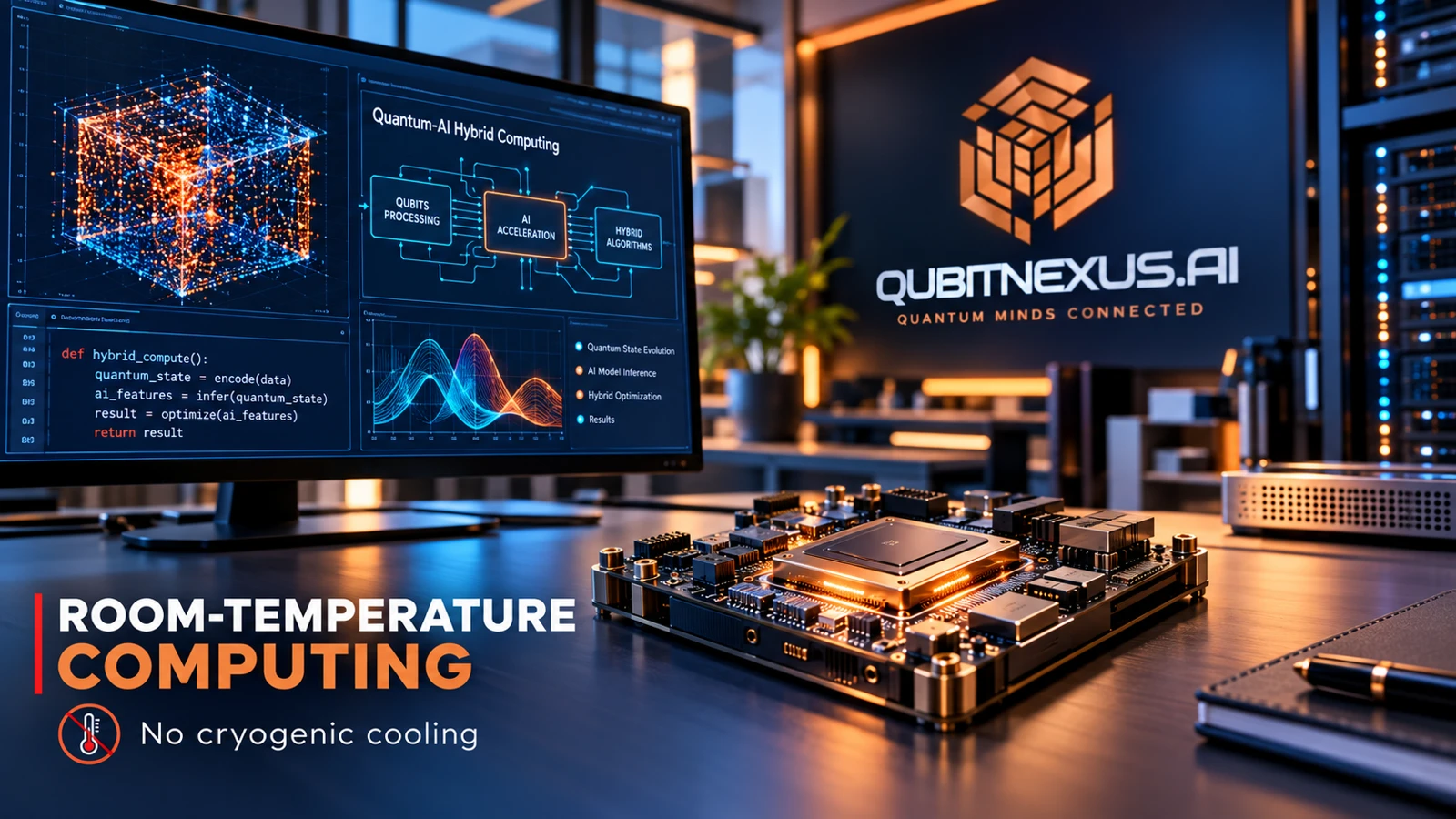
QubitNexus.AI describes application software for a partner’s chip operating at room temperature without cryogenic cooling. [1] This is the most distinctive element of its stated direction: reducing the infrastructure requirements associated with extreme cooling and opening a different route towards the use of advanced computation.
The transformative potential of that approach can be understood through accessibility. Installation, environmental requirements and day-to-day operation influence who can use a technology. Simplifying those conditions could bring computation closer to the origin of data and to the people who need its output. This is an especially interesting prospect for industrial settings, where a solution must find a place within an existing facility and working rhythm.
Quantum computing uses physical properties that allow selected problems to be represented and processed differently. Its development involves hardware, algorithms and cooperation with classical computers. [13] That creates scope for specialised workflows. Preparing information, executing a particular computational task and applying its answer can form one process spanning several types of resource.
The room-temperature direction gives this discussion an infrastructural dimension. The future of computing concerns both mathematical possibilities and the physical conditions required to use them. For an industrial organisation, those levels are inseparable: a useful result must be produced somewhere it can be obtained, received and put to work.
TongueChow.AI and the Q11L language
The company describes TongueChow.AI, developed since 2024 using Q11L, as a quantum error-correction platform available for demonstration. [1] The project adds a specific software strand to the wider discussion of computing infrastructure. Programming becomes part of the work on making computation dependable and useful.
The importance of error correction follows from a fundamental goal of system design: a result needs to retain its meaning in the conditions under which a device operates. Engineering therefore considers both the ability to perform a task and the treatment of disturbances that affect it. Work largely invisible to the end user can determine the value of the complete solution.
A dedicated programming language adds another dimension to a technology venture. A language shapes how problems are expressed and procedures are constructed; together with its tools, it influences the developer’s working process. For a company exploring a different computing approach, that becomes a way to shape its technical environment, from the expression of a task through to execution and assessment.
Intelligence close to the source of information
Edge computing places some processing closer to devices and the data they produce. It can shorten the route from information to a useful result and reduce the need to send an entire stream to remote infrastructure. [14] Combined with AI, it creates opportunities for systems that respond near the place where an event occurs.
Consider an organisation operating across multiple locations. Each site collects information needed for immediate work, while combining experience across the network supports longer-term planning. An architecture can assign local tasks close to users and bring broader analysis into a shared environment. Cooperation between these layers gives designers more ways of matching a system to an operational process.
This is also where technology meets responsibility for information. The location of processing affects access, data flows and maintenance. For a project leader, it is part of strategy; for an engineer, it is part of architecture. Experience with devices and the study of IoT fit naturally into this conversation about the future of intelligent services.

Energy belongs in the design
As advanced computing becomes more widely used, the demands placed on resources belong among the earliest design considerations. Decisions about moving, storing and processing information have consequences for a complete system. Efficiency can therefore be understood as the ability to perform useful work with appropriately chosen technical requirements.
From that perspective, an architect influences more than the response time of an application. They can ask whether information needs to be processed again, which tasks require the greatest capability and how work should be distributed. These choices connect computing with the organisation of a process. They also create space for innovation in aspects previously treated simply as infrastructure costs.
In our reading, this is a significant part of the direction QubitNexus.AI has chosen. It brings the conditions under which intelligence operates into the discussion of what intelligence might achieve. Emerging computational methods meet the need to build environments that can be developed and used in practice. The AI transformation has a material foundation: equipment, energy and human work.

International exchange and recognition
Kathrin’s professional activity also includes conference participation. The official BITS Pilani Dubai Campus bulletin lists her among the keynote speakers at ICAIN 2025, held on 6–7 October 2025 in cooperation with IIIT Allahabad. [16] The independent unDavos 2026 programme places her in discussions about enterprises in the age of AGI and organisational change around AI. [10]
In 2024, she received the Forttuna Global Excellence Awards distinction of Business Woman of the Year, Norway, in the SME category. [11] Her activity connects industrial and educational environments with public discussion of technology. These are useful meeting places because the development of AI also depends on cooperation between people with different responsibilities and experience.
A scientific conference brings research questions, a university offers space to organise them, and an enterprise supplies the demands of application. Someone moving between these environments can help knowledge travel and make problems visible across professional boundaries. That multidirectional exchange is an important theme in Kathrin’s career.
Leadership for the age of intelligent systems
AI governance encompasses the processes, standards and oversight accompanying the development and use of systems. [15] In practice, it concerns the relationship between technology and people: who makes a decision, who understands its basis and who can respond when a problem occurs. For an organisation developing AI, these are concrete design questions alongside infrastructure and data preparation.
Three connected perspectives recur in Kathrin’s work. Engineering directs attention towards the complete system. Academic activity encourages investigation and the sharing of knowledge. Management requires possibilities to become coordinated action. Together, they form a portrait of a leader working between disciplines, where many of the most demanding projects begin.
QubitNexus.AI gives that career a further direction through room-temperature computing, its own programming environment and the integration of different ways of working with information. The ambition is substantial: to make advanced intelligence part of useful infrastructure. Kathrin’s story shows why pursuing that ambition requires science, industrial experience and the ability to lead people together. Their combination is a productive place to look for the future of technology.
Contact and further information
QubitNexus.AI — company contact
qubitnexus.ai ↗
info@qubitnexus.ai
Sources and background
- QubitNexus.AI — company, services and stated research direction ↗
- SSBM Geneva — faculty biography: Dr. Kathrin Kind-Trueller ↗
- SSBM Geneva — Advisory Board appointment, 16 December 2024 ↗
- SSBM Geneva — Applied AI, ethics and future jobs, 16 October 2025 ↗
- Paris School of Management — professor and Advisory Board interview, 7 October 2025 ↗
- Wiley / Strategic Change — From Shadow IT to Shadow AI–Threats, Risks and Opportunities for Organizations, 24 June 2025; DOI 10.1002/jsc.2682 ↗
- CRC Press / Routledge — Data-Driven IoT Ecosystems, publisher catalogue ↗
- Google Books — Data-Driven IoT Ecosystems, bibliographic record: 30 October 2026, 292 pages ↗
- World Economic Forum — public profile: Dr Kathrin Kind ↗
- unDavos — Kathrin G. Kind, 2026 independent conference programme ↗
- Forttuna Global Excellence Awards — 2024 winner profile ↗
- SSBM Geneva — Executive DBA and professional development interview, 10 January 2025 ↗
- IBM Think — What is quantum computing? Updated 2 April 2026 ↗
- IBM Think — What is edge computing? Updated 31 March 2026 ↗
- IBM Think — What is AI governance? Updated 8 July 2026 ↗
- BITS Pilani Dubai Campus — institutional report on ICAIN 2025, 6–7 October 2025, p. 88 ↗